11 Must-Have Tools for Coordination in Global Teams

Whether you're juggling a marketing team spread across Sydney, Stockholm, and São Paulo — or launching a new product with engineers in five time zones who’ve never met in person — global collaboration is now standard practice.
But here’s the kicker: the remote tool boom hasn’t exactly made work easier. If anything, it’s turned your workday into a game of “Which tab has the answer?”
Messages vanish. Deadlines drift. Context gets scattered across apps that don’t even acknowledge each other’s existence.
So what do remote teams actually need now?
This article breaks down the messy remote work landscape and shows you how to build a tech stack that supports — not sabotages — global collaboration. From compliance and localization to async workflows and tool consolidation, you’ll walk away knowing exactly what to look for in 2025.
Ready to rethink what “remote-ready” really means? Let’s get into it…
Why switch between apps all day when your remote team can have everything in one platform?
Bitrix24 gives you video meetings, task tracking, cloud storage, and more—built to make remote work smarter.
Get Started TodayWhat makes global remote work unique?
Managing a remote team is one thing. Managing a global remote team? That’s a different level entirely.
You’re not just dealing with distance. You’re juggling time zones, languages, legal standards, tech access, and culture — all while trying to keep communication clear and momentum strong.
Here’s what makes global collaboration so uniquely complex — and where your tools need to do more:
Time zones aren’t just inconvenient — they’re operational roadblocks
Coordinating across New York, Berlin, and Manila? There’s no perfect overlap. Someone’s always staying late or waking up early — and over time, that wears people down.
But it’s not just about meetings. Project timelines, shift handovers, and customer response times all get tangled if your tools don’t support asynchronous work. You need platforms that help everyone move forward, even when they’re not online together.
Language and culture shape every interaction
Global teams bring rich diversity — and subtle communication challenges. Tone, formality, and expectations vary widely. Without shared context, misunderstandings are easy.
Language barriers also impact productivity quietly. If a teammate isn’t fluent in English, navigating a complex interface can slow them down. Tools that offer multilingual interfaces and context-aware support make a big difference — and show your team you care.
Compliance isn’t one-size-fits-all
Every country has different rules for data privacy, employee rights, and digital communications. What works in the U.S. could break GDPR in the EU or run afoul of sovereignty laws elsewhere.
If your platform doesn’t adapt to regional regulations — or help you manage them — you’re increasing risk with every new hire.
Infrastructure varies by region
While some of your team has fiber internet and modern devices, others may be working from mobile hotspots or legacy hardware.
That’s why tools that assume always-on, high-speed access create friction. Look for platforms that offer low-bandwidth modes, mobile-first design, or offline access to level the playing field.
Tool sprawl hits harder when you’re remote
In an office, switching between five platforms isn’t ideal — but it’s manageable. In a global setup, it becomes chaos. Conversations get lost, work gets duplicated, and critical updates get missed.
The more disconnected your tools, the harder it is to keep people aligned. Centralized platforms with built-in integration reduce confusion — and build real momentum across borders.
Core categories of remote work tools (and how global teams should think about them)
There’s no shortage of remote work tools out there. But for global teams, success doesn’t come from having more software — it comes from having the right tools that work well together.
These five categories form the foundation of modern remote collaboration. If your stack covers these — and connects them — you’re already ahead.
1. Communication: real-time and async
You need more than chat. Global teams rely on communication that respects time zones and work styles.
Look for:
- Instant messaging with threads and mentions
- Video calls for key face-to-face moments
- Async video or voice updates (e.g. voice notes, Loom-style)
- Persistent discussions that are searchable and context-rich
The best tools combine these modes, so your team isn’t switching tabs just to stay in sync.
2. Project visibility + workload tracking
When you can’t drop by someone’s desk, you need visibility without micromanagement.
Prioritize tools that offer:
- Clear task ownership and due dates
- Custom workflows by team or region
- Time zone-aware scheduling and reminders
- Lightweight time tracking or effort logging
Bonus: if it’s built into your task view — not buried in a separate tool.
3. Document collaboration and file sharing
Versioned email attachments don’t cut it anymore.
Global teams need:
- Real-time editing with inline comments
- Role-based file permissions
- Cloud storage accessible from anywhere
- Multilingual-friendly interfaces
The faster your team can co-edit and access files, the faster decisions get made.
4. HR, onboarding, and compliance basics
Hiring across borders introduces complexity — from local holidays to document handling.
Look for platforms or integrations that support:
- Localized onboarding checklists
- Time-off tracking by region
- Legal document workflows with e-signatures
- Global payroll and compliance alignment
These aren’t just back-office issues — they shape how your team experiences remote work.
5. Integration: fewer tools, more flow
A global team using three connected tools will always outperform one juggling twelve disconnected ones.
Prioritize:
- Built-in integrations across communication, tasks, docs, and admin
- Automation options to reduce repetitive hand-offs
- One platform that brings everything together
Fewer silos = fewer delays, clearer ownership, and better momentum.
The real problem: Most tools weren’t built for global scale
Remote work software has come a long way. But most tools were designed for small, office-based teams — not for globally distributed workforces.
They handle the basics. But layer in multiple time zones, languages, compliance needs, and async workflows? That’s where things break.
Here’s where traditional tools often fall short:
Tool overload creates chaos, not clarity
It’s not uncommon to juggle 10–15 platforms: one for chat, another for projects, others for file sharing or time tracking. Multiply that across regions and roles, and the problems stack up fast:
- Time lost switching between apps
- Inconsistent team experiences
- Duplicated work and siloed data
- Admin overhead just to manage access
Instead of speeding things up, your tools become the work.
Localization is an afterthought
Many tools assume everyone works the same way — and in English.
That creates issues like:
- Confusing formats for dates, times, or currencies
- English-only interfaces and support docs
- Cultural disconnects in tone and structure
These barriers slow teams down and erode engagement — especially when they go unaddressed.
Async collaboration is poorly supported
Most platforms still expect everyone to be online at the same time.
But global teams rely on async work. Without features like:
- Scheduled messages
- Digest-style updates
- Time zone-aware task assignments
…you’re stuck chasing replies and duplicating efforts — instead of moving forward.
Most platforms weren’t built to support this kind of complexity — but that’s exactly what global teams need. Not just another tool in the mix, but a system designed for visibility, flexibility, and async-first collaboration across borders.
That’s where Bitrix24 comes in.
How Bitrix24 solves for global remote teams
Every challenge we’ve covered — tool sprawl, localization gaps, async friction, compliance headaches — Bitrix24 was built to solve.
Whether you're managing a lean startup across three countries or leading a global division with hundreds of users, Bitrix24 gives you a unified platform that adapts to how international teams actually work.
Here’s how it helps:
1. Work without tool sprawl
Bitrix24 combines everything you need in one place:
- Messaging (with threads, mentions, and voice notes)
- HD video calls and conferences
- Project and task management with Gantt, Kanban, and automation
- Document sharing, live editing, and version control
- CRM, HR tools, time tracking, and workflows — all natively connected
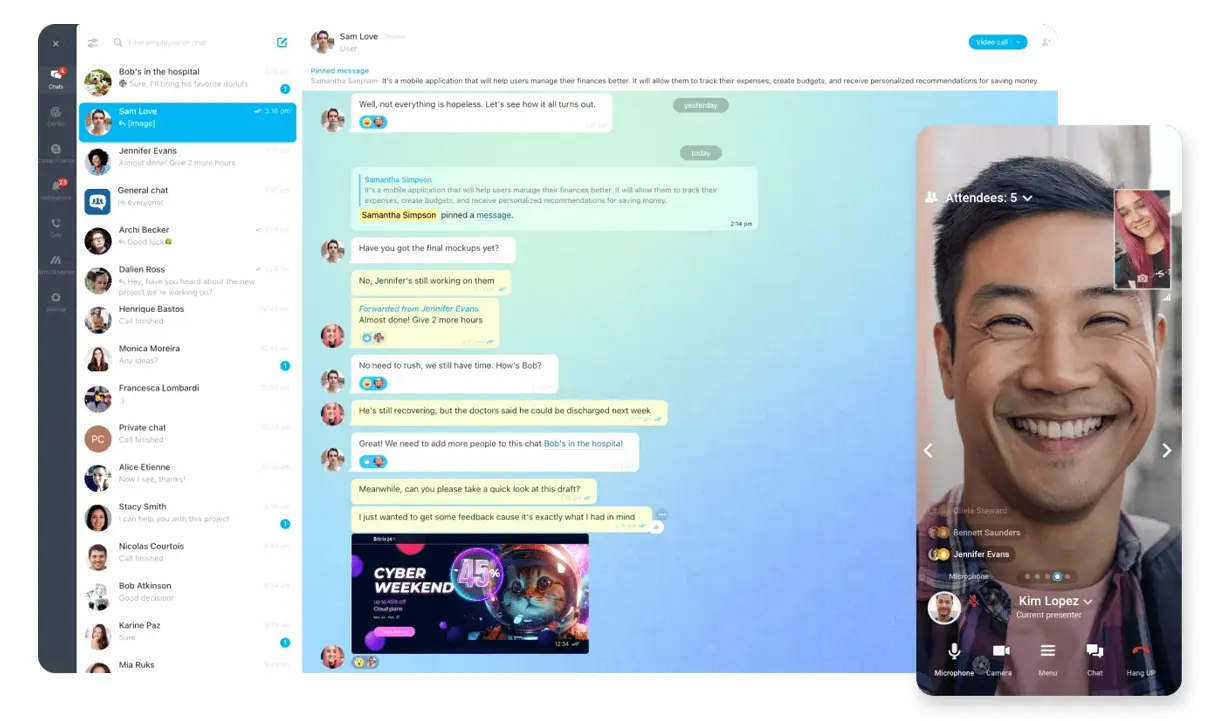
No more switching apps. No more disjointed data. Your team stays focused and aligned.
2. Localized for every region, every user
Bitrix24 supports 20+ languages and lets each teammate personalize their interface.
You also get:
- Auto-detected time zones and conversions
- Local date, currency, and number formats
- Region-specific calendars and holiday visibility
- Role-based access that adapts to your org’s structure
Whether your team is in São Paulo, Berlin, or Jakarta, collaboration just works — without extra setup.
3. Built-in compliance and secure operations
You stay in control with features designed for global standards:
- GDPR-ready by default
- Data hosting options by region (EU, US, etc.)
- Admin logs, audit trails, and permission controls
- Self-hosted deployment for maximum data sovereignty
Bitrix24 helps you scale safely — without legal blind spots.
4. Fast, friction-free onboarding
Getting new hires up to speed is easy, wherever they are.
With Bitrix24, you can:
- Assign onboarding checklists with deadlines
- Share documents, videos, and wikis in one workspace
- Automate HR and IT steps with recurring tasks
- Use async updates via task comments or voice notes
Even if your HR team is in Canada and your new hire is in Vietnam, onboarding stays consistent and scalable.
See what Bitrix24 can do for your global team
From async collaboration to region-ready compliance, Bitrix24 gives you everything you need to stay productive, aligned, and scalable — all in one platform.
If your current tools are holding you back, it’s time to move forward.
Implementation tips: Rolling out remote tools globally
Choosing the right platform is only half the battle. Getting your global team to actually use it — across languages, time zones, and departments — is where most companies struggle.
But with a clear rollout plan, you can drive adoption, minimize friction, and set your team up for long-term success.
Here’s how to do it.
1. Audit before you add
Before introducing new tools, get clarity on what’s working — and what’s holding people back.
- Survey teams across regions and roles
- Identify overlapping tools or unused licenses
- Pinpoint gaps: poor visibility? weak onboarding? limited mobile access?
- Prioritize issues that impact collaboration, not just convenience
This ensures your solution matches your team’s reality — not assumptions.
2. Roll out in smart, regional phases
Don’t launch to everyone at once. Instead:
- Start with a test team in one region
- Gather feedback on onboarding, usability, and support
- Refine your setup before expanding
- Use “local champions” to drive peer-level adoption
This staged approach builds momentum — and prevents global resistance.
3. Localize your training paths
One-size-fits-all training won’t work for a distributed team.
- Offer video walkthroughs with subtitles or multilingual voiceovers
- Create regional onboarding guides with screenshots
- Run live Q&As across time zones
- Use your platform’s tracking to monitor training progress
The goal is confidence — not just access.
4. Make async workflows the default
Build habits that reduce your team’s dependence on meetings and real-time pings.
- Replace daily standups with task-based status updates
- Use shared calendars that show time zone overlap
- Encourage comment threads and voice notes
- Document decisions in wikis or persistent chat spaces
Your platform should enable async work — not work against it.
5. Keep feedback flowing
Global rollouts aren’t “set it and forget it.” Keep listening.
- Set up a shared feedback form or support group
- Schedule quarterly retros on tool performance
- Build a champion network to surface insights early
- Regularly review setup as your team grows
This helps prevent silent churn — and keeps your platform evolving with your team.
When you implement with care and cultural awareness, remote tools don’t just improve productivity — they strengthen your global culture.
Remote work isn’t going anywhere — are your tools ready?
Remote work is no longer a temporary fix. It’s a strategic advantage — but only if your tools are built for it.
You’ve seen the risks of scattered systems, outdated software, and one-size-fits-all platforms. You’ve also seen what it takes to support a global team: localization, visibility, integration, and workflows that work across time zones.
Here’s your action list moving forward:
- Consolidate your stack — fewer tools, more impact
- Prioritize localization and timezone intelligence
- Make async workflows the default, not the backup plan
- Choose platforms that scale across regions and roles
- Roll out with care — listen, adapt, and train intentionally
And if you’re ready to simplify all of that in one place?
Bitrix24 gives you the complete platform — in 20+ languages, with built-in compliance, automation, and everything remote teams need to move fast, stay aligned, and work like one.
Because global teams don’t just need tools.
They need one space where great work happens — anywhere.