Free Landing Page Builder: Create High-Converting Pages Faster
A landing page is only as valuable as what happens after someone fills out the form.
Most builders make the design part easy. The real gap is everything that follows: where the lead goes, how fast you respond, and whether your follow-up actually happens. A page that converts but feeds into a broken process hasn’t solved anything.
This guide covers what separates a landing page builder that helps you capture leads from one that helps you close them, and how to build pages that do both.
TL;DR
- A free landing page builder lets you launch a focused, mobile-ready page in minutes without coding or developer help.
- The best tools go beyond design, capturing leads directly into a CRM, automating follow-ups, and connecting every form submission to your sales process.
- Industry research shows the median landing page converts at 6.6%, meaning the difference between a decent page and a high-performing one is almost always optimization and lead handling, not the page itself.
- Match your builder to the full journey (from page to CRM to follow-up) rather than to template count alone, and free tools can deliver paid-tier results.
Who this is best for
Free landing page builders are best for small businesses, marketers, founders, and sales teams that need to launch campaign pages quickly, capture leads, and connect form submissions to a CRM without developer support.
When a free builder may not be enough
A free builder may not be enough for enterprise teams that need advanced A/B testing, complex personalization, strict compliance workflows, or high-volume analytics across multiple brands.
What a landing page builder actually does
A landing page builder lets you create standalone web pages designed around a single goal — usually capturing leads or driving one specific action. Unlike a traditional website, a landing page removes distractions. No navigation menus, no competing messages. Every element is focused on one outcome.
That focus is why landing pages work so well for paid ads, email campaigns, product launches, and marketing lead generation funnels:
- Paid ads where relevance directly affects conversion rate and cost per click
- Email campaigns promoting a specific offer
- Product or service launches
- Lead generation funnels for sales teams
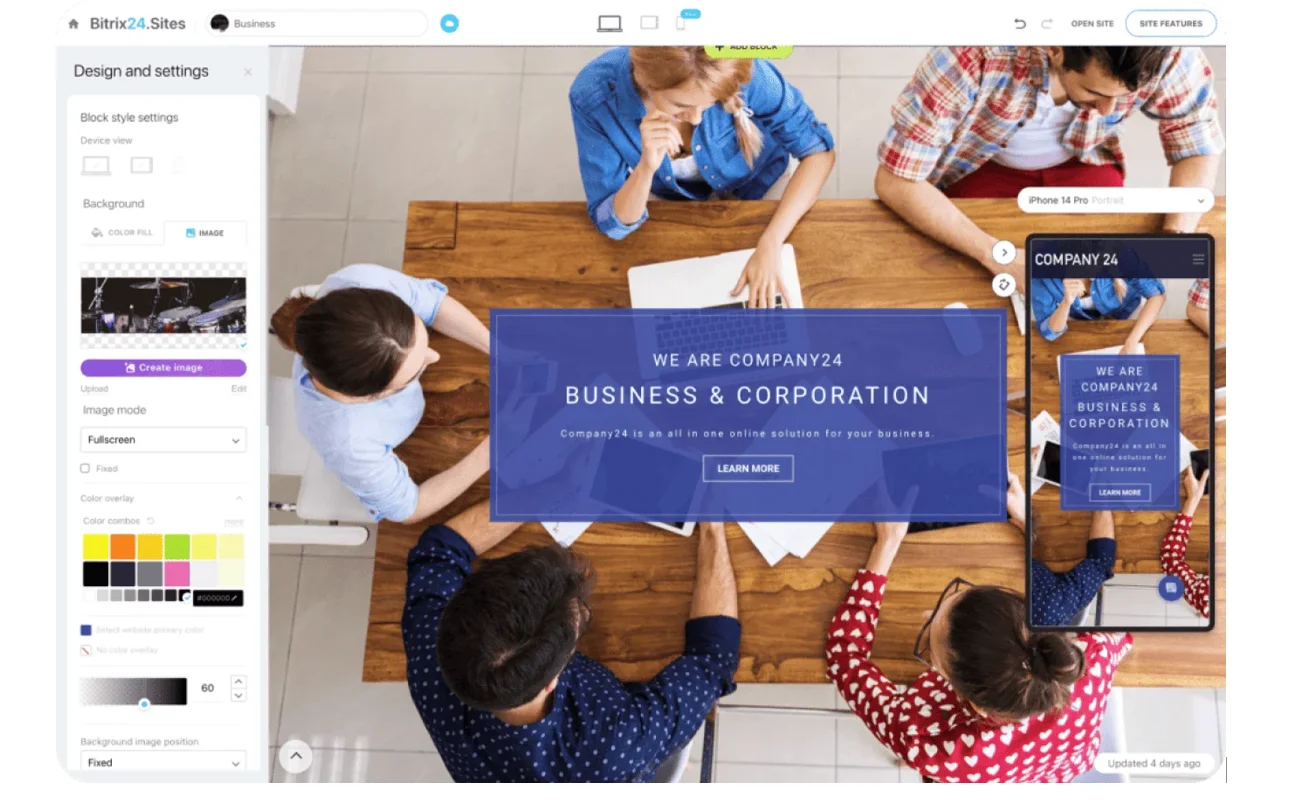
A builder simplifies the process at every step. Instead of relying on developers, you choose a template built around your goal, customize the message and visuals, and publish in minutes. The better builders also connect the page directly to your lead management process, so every form submission is captured, organized, and ready for follow-up without manual work.
That's where landing pages stop being marketing assets and start being part of your revenue workflow.
Why free builders have become seriously competitive
The capability gap between free and paid landing page tools has narrowed dramatically. A few years ago, "free" meant limited templates, weak mobile rendering, and no CRM integration. Today, free tiers from serious platforms include most of what small and mid-sized teams actually need.
The strategic advantage of free tools isn't just cost — it's iteration speed. You can test ideas, validate offers, and start generating leads without committing budget before you know what works. For time-sensitive campaigns, that matters more than any premium feature.
The real value, though, comes from what happens after someone converts. The best free builders don't stop at lead collection. They connect leads to a system where you can track, manage, and follow up automatically.
In tools like Bitrix24, that can mean form submissions flowing straight into your CRM as leads, deals, or contacts, with follow-up actions triggered from the same workspace. That removes the delay between first click and first conversation.
[image removed]
The numbers behind what actually converts
Landing page optimization isn't guesswork anymore. Unbounce's 2024 Conversion Benchmark Report analyzed over 57 million conversions across 41,000 landing pages and 464 million unique visitors — the largest public dataset of its kind — and the findings reshape how most teams should think about landing page performance.
Key findings that directly affect your builder choice:
- The median conversion rate is 6.6% across all industries, with top performers hitting 10%+
- Copy written at a 5th-to-7th grade reading level converts at 11.1% — nearly double the 5.3% rate of college-level copy
- Mobile drives around 83% of traffic, but converts 8% lower than desktop, meaning improving the mobile user experience is where most pages leak conversions
- Email campaigns convert at 19.3% median — higher than paid social (12%) or paid search (10.9%)
The features that move these numbers — mobile rendering, form simplicity, readability, analytics, CRM integration — matter more than template count or visual polish.
Key features that drive conversions
Not all landing page builders deliver the same results. These are the capabilities that directly impact conversion performance, and why they matter.
|
Feature |
Why it matters |
|---|---|
|
Templates built for results |
Proven conversion patterns eliminate guesswork on structure and flow |
|
Drag-and-drop editor |
Fast iteration means faster conversion rate improvement |
|
Mobile-responsive design |
83% of traffic is mobile; poor rendering kills leads before they engage |
|
Built-in forms and pop-ups |
Native capture keeps data consistent and reduces setup friction |
|
CRM integration |
Every submission captured and organized without manual transfer |
|
Analytics and tracking |
Visibility into drop-off points and element performance enables targeted optimization |
CRM integration deserves extra attention. Capturing a lead is only valuable if you can act on it quickly. Without direct CRM flow, leads sit in form exports, get delayed in handoff, or miss follow-up windows entirely. Platforms like Bitrix24 combine landing pages and CRM into a single system, so there's no gap between lead capture and lead management.

How to create a high-converting landing page
Building a page is straightforward. Getting it to convert consistently requires discipline in a few places.
- Start with one clear goal. Define exactly what you want the visitor to do — sign up, download, or book. Combining multiple goals lowers conversion.
- Match your message to your traffic. If someone clicks a Facebook ad, your headline should reflect that exact offer. Consistency builds trust within the first five seconds.
- Write a clear, benefit-driven headline. Focus on the outcome, not the feature. Keep language simple — remember, 5th-to-7th-grade reading level nearly doubles conversion over professional-level copy.
- Use visuals to reinforce the offer. Product screenshots, short demo videos, or contextual images that show the outcome. Purposeful visuals only — decoration hurts performance.
- Add a clear, visible call-to-action. Use action-oriented language ("Get Started," "Book a Demo"), make it visually distinct, and repeat on longer pages. Clarity beats creativity.
- Reduce friction in your forms. Start with name and email only. Ask for more only when essential. Every extra field reduces completion rate — and pair short forms with automated lead management so momentum carries straight into follow-up.
- Optimize for mobile from the start. Readable text sizes, thumb-friendly buttons, natural flow on small screens. Review on an actual phone before publishing.
- Test and improve continuously. Headlines, CTA wording, and section order are the highest-leverage variables. Built-in analytics makes testing efficient rather than intuitive.
Edge cases most landing page guides skip
Standard advice doesn't fit every scenario. Here's when defaults shift.
1. High-ticket B2B offers with long sales cycles. Short forms and minimal context work for top-of-funnel offers. For a $50K annual contract, you need longer pages, stronger trust signals, and forms that qualify intent (even at the cost of lower raw conversion numbers).
2. Cold traffic from display or interest-based social ads. Visitors aren't actively searching for your solution. Your page needs to establish the problem first, then the offer. Short "get the demo" pages fail here; education-first pages work better.
3. Geographically regulated offers (financial services, healthcare, legal). Compliance requirements shape what you can say, what disclaimers you need, and what data you can capture. Build these into your template early — retrofitting compliance language into optimized copy rarely preserves conversion performance.
4. Time-critical launch campaigns (product releases, event registrations, flash sales). Speed trumps polish. Pick a template, fill it with your core message, publish, and iterate on live traffic. A 5% page live today beats a 10% page launching next week.
5. Retargeting campaigns. Visitors already know you. Aggressive CTAs, stronger urgency, and shorter forms outperform educational content. Build a separate retargeting page rather than sending returning visitors to your cold-traffic version.
6. Multi-language or multi-region campaigns. Translation alone isn't enough — cultural expectations around formality, trust signals, and CTA directness vary significantly. Test region-specific versions rather than assuming one localized page fits all markets.
Why Bitrix24 stands out as a free builder
Most free builders help you publish the page. Bitrix24 is stronger when you also need to manage what happens after conversion.
With Bitrix24, you can:
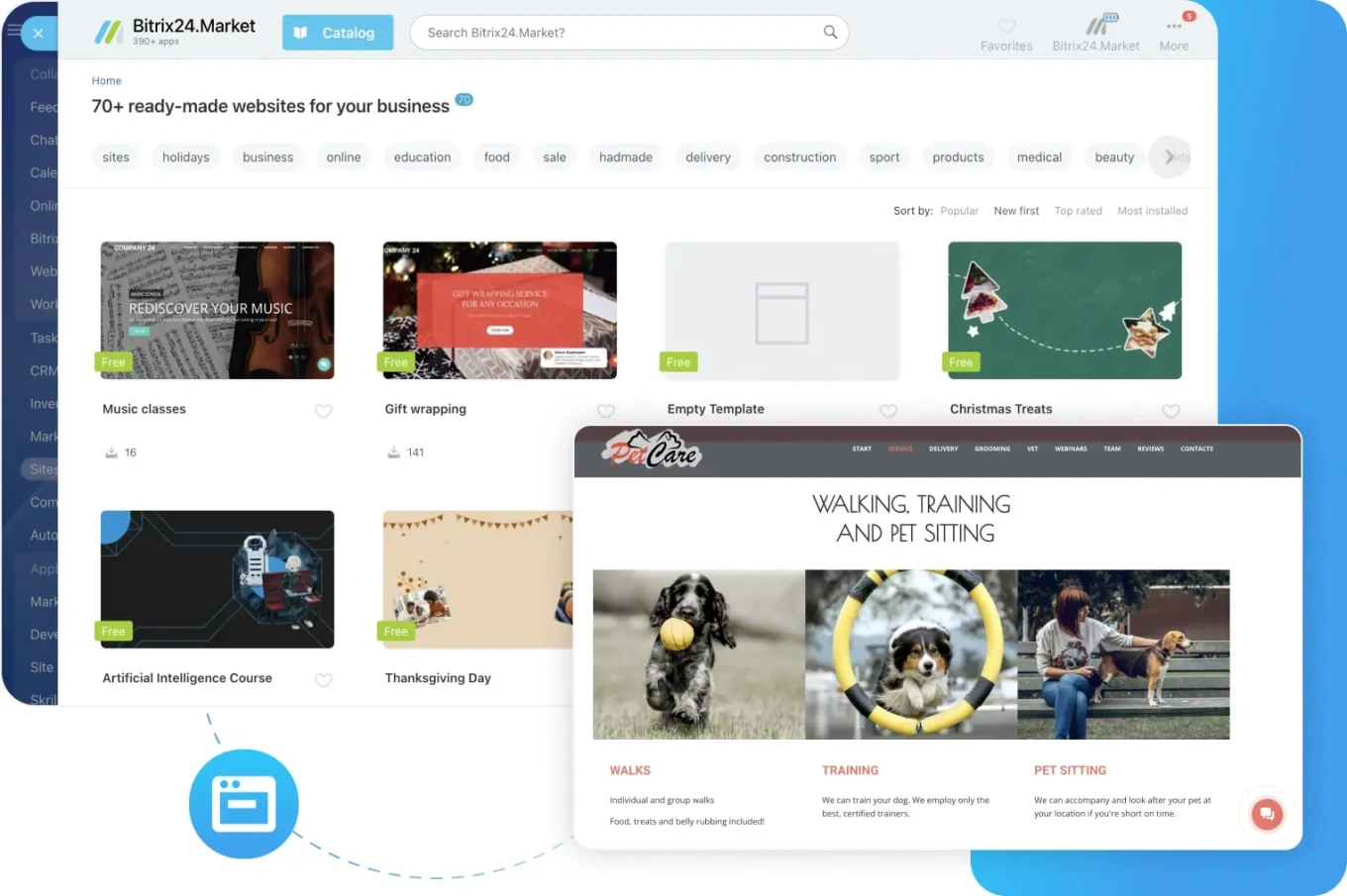
- Build landing pages using 100+ templates, mobile-responsive design, free hosting, and AI-generated page creation through CoPilot
- Add customizable lead capture forms, booking forms, callback forms, surveys, event registration forms, and conditional fields
- Send form submissions directly into Bitrix24 CRM as leads, deals, or contacts
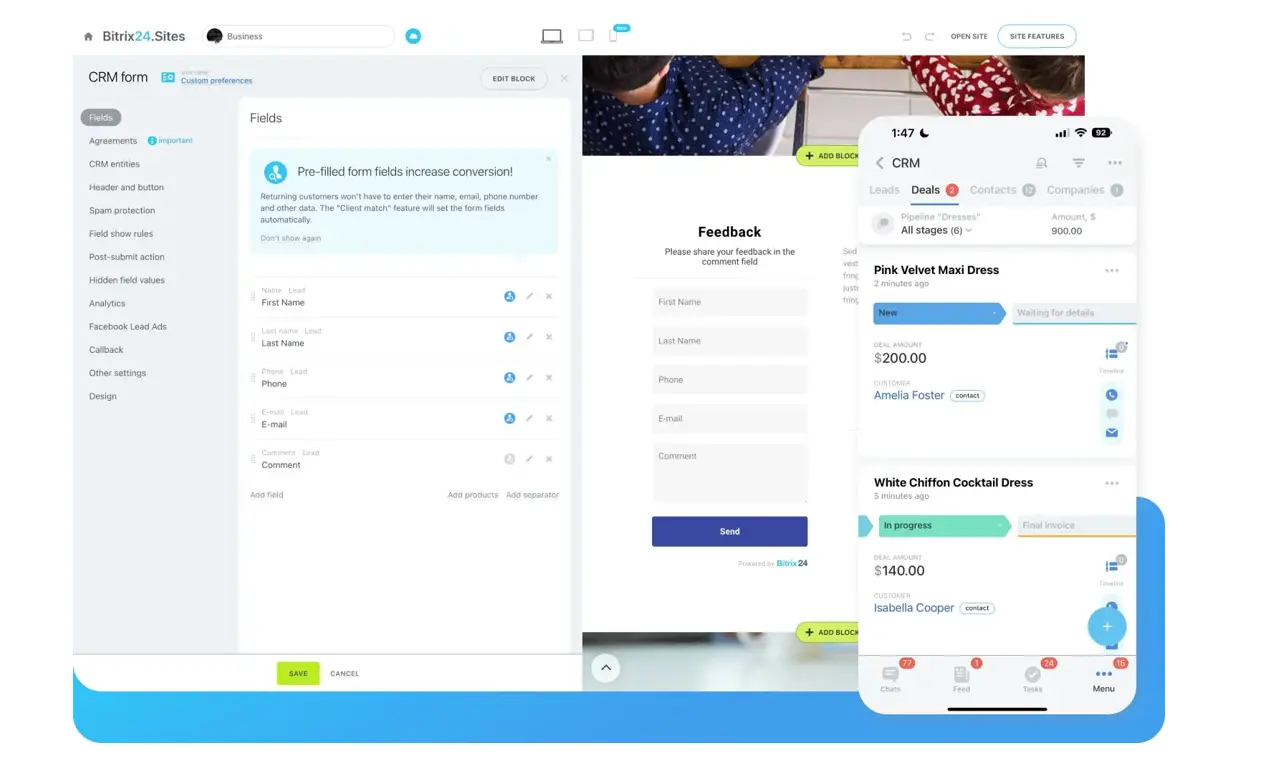
- Capture submitted forms, phone calls, and chat messages as CRM records
- Trigger follow-up actions such as emails, SMS messages, tasks, notifications, or calls
- Use booking tools for self-booking, waiting lists, and automated reminders via SMS or WhatsApp
- Connect sales pipelines with sales tunnels so deals move into the right next stage automatically
- Generate online payment links directly from deals
- Track landing page performance through GA4, including page views, bounce rate, downloads, and submitted forms
That makes Bitrix24 a better fit for teams that don’t just need a landing page. They need a page that connects directly to CRM, follow-up, scheduling, analytics, and sales activity.
Tips to improve your landing page results
Creating the page is the starting point. Real gains come from refining how it performs once traffic arrives.
- Keep message alignment tight. Headline matches ad promise, offer is immediately clear, one core idea per page.
- Optimize for intent, not just design. Cold traffic needs more context; warm traffic converts with shorter, more direct pages.
- Reduce decision friction. Cut unnecessary fields, simplify wording, make the next action obvious.
- Use trust signals strategically. Testimonials, client logos, or guarantees — small additions that compound confidence.
- Introduce urgency where genuine. Limited-time offers, countdowns, or capacity-based messaging. Manufactured urgency backfires.
- Focus on speed and performance. Even small load delays cause drop-off. Strip heavy elements and prioritize fast first paint.
- Treat optimization as ongoing. Highest-performing pages improve through testing, not redesign. Connect pages to analytics and CRM data so you can see which leads actually become customers.
The bottom line: build for the full journey, not just the page
The page is the easy part. Most builders will get you live in minutes — that problem is solved. The harder question is what happens next: where the lead goes, how fast your team responds, and whether any of it feeds back into a process you can actually improve.
That's the gap Bitrix24 closes.
Landing pages connected directly to your CRM, your follow-up workflows, and your sales pipeline — so the distance between first click and first conversation is as short as possible.
Start free and see how much of your process you can consolidate.
Launch Landing Pages Swiftly!
Experience Bitrix24's free builder that not only offers stunning design templates, but also empowers your CRM system with automated lead capture and follow-ups.
Try Bitrix24 nowFrequently asked questions
Do free landing page builders really work for professional campaigns?
Yes, free tiers from serious platforms now include mobile rendering, form capture, analytics, and CRM integration. For most small and mid-sized campaigns, the feature gap with paid tools is small enough that iteration speed and CRM depth matter more than price tier.
How many landing pages should I build per campaign?
At least one per audience segment or traffic source. Generic pages that try to address multiple audiences consistently underperform targeted ones. Build more pages with tighter focus rather than fewer pages with broader copy.
How quickly can I realistically launch a new page?
With a template-based builder and existing brand assets, 30 minutes to 2 hours for a first version. Optimization comes afterward with live traffic. Don't delay launch waiting for perfection — a live page generating data beats a perfect page sitting in draft.
What's the biggest factor in landing page conversion rate?
Message-match between ad and page, followed by form simplicity and mobile rendering. Those three fix more conversion problems than any design change.