How to Create a Plot Diagram to Outline the Plot Structure

Usually, a plot diagram is a term many hear throughout literature studies or when learning to write one's own story. A plot diagram helps you visualize and follow your story arc, creating a compelling narrative with a strong, cohesive plot.
In business, storytelling is a comprehensive base. It is vital for captivating your audience with logical conclusions, pitching your ideas to investors, filming content, and so much more.
In this comprehensive guide, you'll learn what a plot diagram is, explore essential plot elements, discover various story structure templates, and master the process of creating your own plot diagram to enhance your writing as well as business processes.
What Is a Plot Diagram?
A plot diagram is a visual representation of a story, including its structure and integral components that help both writers and readers comprehend the narrative arc. Simply put, it allows you to navigate and track the main events within your story, providing a roadmap for your creative journey.
It can be difficult to differentiate between plot and story. While this topic remains debatable among literary scholars, there's a straightforward way to understand the distinction: the story (the what) encompasses the main actions, while the plot (the how) provides logical connections between these actions.
Tip for Business Storytelling
If you do not know where to start outlining a plot diagram, start with Bitrix24 Online Whiteboard.
The pen tool can be used to draw the arс. Use the Sticky Notes to map the main event. Team members can edit the board in real time until they create a plot diagram that represents the workflow.
How Plot Diagrams Work
At its core, a plot diagram serves as the backbone of your story. It outlines critical details of your literary work, including:
-
Main characters and their development paths
-
Necessary context for the narrative
-
Setting and world-building elements
-
Decisive turning points and conflicts
A plot diagram typically appears as a linear graphic that illustrates the narrative arc of your story's progression. A detailed plot structure diagram becomes an invaluable tool for both writers and readers since it visualizes the main story elements.
This graphic organizer is irreplaceable for remembering how your story progresses throughout the writing process. The basic structure of a plot diagram is divided into three major segments: beginning, middle, and end. Within these segments, the main story elements are distributed: Exposition, Conflict, Rising Action, Climax, Falling Action, and Resolution.
Explore Bitrix24 AI Powered Tools
Struggling with writer's block? Let Bitrix24 CoPilot guide you! Explore our content writing chat tools to spark creativity and improve your writing process.
Try nowKey Elements of Plot Diagrams
Creating a story map is vital to help writers and students understand the entire narrative, keeping readers engaged with a quality story structure. As mentioned earlier, the main plot of every story arc includes exposition, conflict, rising action, climax, falling action, and resolution. Let's break down each plot element in detail.
1. Exposition
Exposition is the starting point of the linear diagram, which presents the general story arc. In this part, the author provides all the necessary information to understand the central conflict.
The introductory details provided in the exposition usually include:
-
Names and preliminary characteristics of main and supporting characters
-
Temporal and geographical setting
-
General mood and tone of the story
-
Relevant background information
-
Initial relationships between characters
Writers and students learn to include time and place descriptions to ground readers in the story world. Effective exposition creates a foundation that supports the entire narrative structure without overwhelming readers with excessive detail.
Business equivalent
This is the stage of inducing the customer and their Status Quo (describing the problem they face). For example:
“Mandy is the manager. She is having trouble following deadlines.”
Tools to Use: Bitrix24 AI assistant Copilot can drive induction hooks to appear to the manager who struggles with deadlines.
2. Conflict (Inciting Incident)
Conflict is the plot element that introduces the primary issue that will drive story development. Here, an event occurs that leads to inevitable conflict. Based on the type of story, it can also be called an inciting incident or an inciting moment since it establishes something the main character must achieve.
In most story structures, the main conflict constitutes the focal point, something the protagonist must resolve or an obstacle they must overcome. This conflict typically falls into one of several categories:
-
Character vs. Self
-
Character vs. Character
-
Character vs. Society
-
Character vs. Nature
-
Character vs. Technology
-
Character vs. Supernatural
-
Character vs. Fate
Both Exposition and Conflict comprise the "beginning" section of the plot diagram.
Business equivalent
The old system's main function causes the main issue. For example, a lack of reminders causes a missed deadline
Tools to Use: Visualize customer journey with a Bitrix24 Whiteboard.
3. Rising Action
The rising action is usually the most extended part of the narrative arc. This is where the story intensifies as the main character attempts to resolve the central conflict, setting the stage for exciting events in the climax.
Rising action adds complexity to the character's journey, providing depth to the story. Not everything in this section needs to connect directly to the main problem.
In this phase, writers can:
-
Explore thematic elements
-
Resolve and establish subplots
-
Provide additional character development
-
Introduce complications and obstacles
-
Build tension systematically
The rising action is crucial for foreshadowing future events and developing character arcs, creating a rich tapestry that draws readers deeper into the narrative.
Business equivalent
Highlighting how the product or service can solve the specific pain and what the result can be of missing out. For example, using old tools can lead to missing a deadline, loss of trust, and increased costs.
Tools to Use: Visualize customer journey with a Bitrix24 Whiteboard.
4. Climax (Turning Point)
The rising action leads to the culmination part, called the climax or turning point. This is the plot structure element with the highest tension—the moment everything has been building toward.
The turning point in the story can be achieved in several ways:
-
The protagonist resolves the main conflict
-
The main character overcomes the primary obstacle
-
A significant revelation changes everything
-
A decisive battle or confrontation occurs
-
A critical choice must be made
Importantly, the resolution at the climax might not favor the protagonist. Sacrifices may be necessary, and some characters might perish to maintain high stakes. Subplots and secondary character arcs typically reach resolution alongside the main issue.
The turning point usually appears as the peak of Freytag's pyramid in a visual plot diagram.
Business equivalent
This is the moment where the customer discovers the product or service. For example:
“Mandy discovers a task management tool with automatic reminders. She realizes that the solution is investing in quality software.”
Tools to Use: Landing page builder. With Bitrix24, you can create a landing page without any coding or technical knowledge to present your product.
5. Falling Action
While rising action is typically the longest part of the act structure, falling action is a much shorter phase. However, the length can vary significantly between stories, depending on what needs to be addressed after the climax.
The falling action is where you provide the emotional and practical closure that leads to a satisfying conclusion. During this phase, characters adjust to the new reality created by the climax's events, dealing with the aftermath and consequences of the turning point.
Elements often addressed in falling action include:
-
Consequences of the climactic decisions
-
Emotional processing of events
-
Tying up loose ends
-
Revealing final twists
-
Setting up the resolution
Business equivalent
Discovering how the tools work and implementing them into the work process. For example:
“Mandy implements a task management tool, sets up priority status and deadlines for each task.”
6. Resolution
Resolution is the final part of the plot diagram that leaves the most lasting impression on readers. It might not always deliver a "happy ending"—it could leave readers with questions or even feelings of confusion or frustration, depending on the writer's intent.
The resolution ties all story elements and plotlines into the narrative's conclusion. The goal is to ensure your story reaches its final points, leaving no unintentional loose ends or plot holes. A well-crafted resolution provides satisfying closure while honoring the story's themes and character journeys.
Business equivalent
Improved efficiency. A customer left positive feedback. For example:
“Mandy does not stress about meeting the deadlines. The project was finished on time.”
Tools to use: CRM forms. Collect feedback from customers, but sending forms and setting up website pop-ups.
Visual Representation of a Basic Plot Diagram
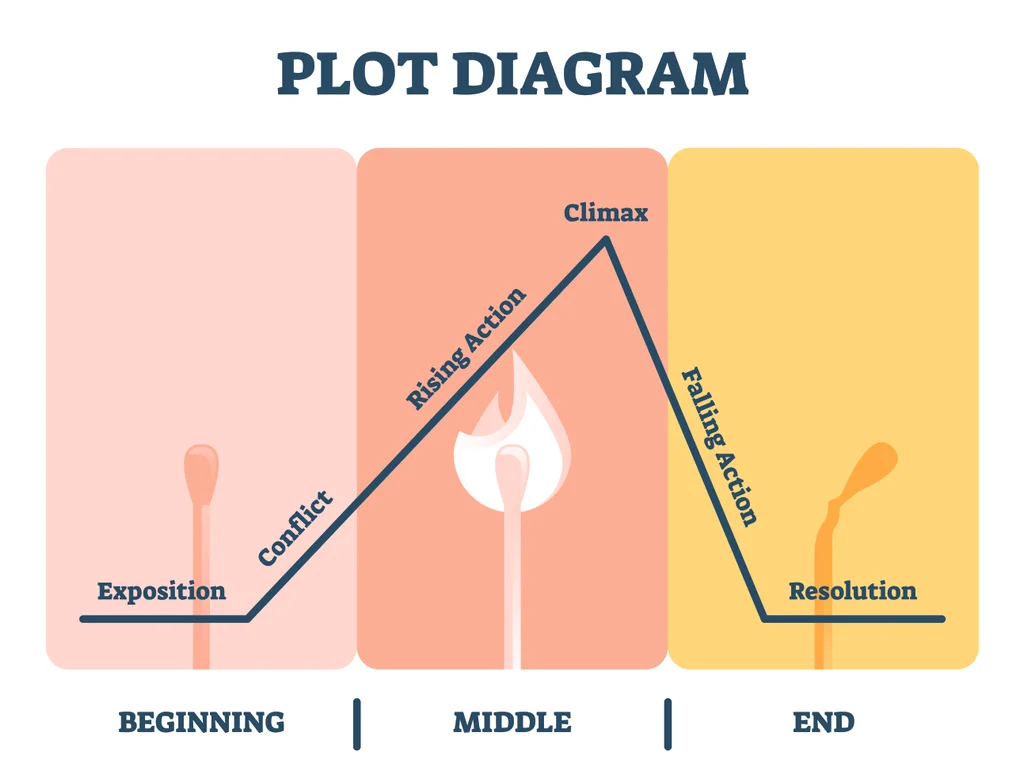
The basic plot diagram resembles a mountain or pyramid, with:
-
Exposition at the lower left
-
Rising Action climbing upward
-
Climax at the peak
-
Falling Action descending
-
Resolution at the lower right
This visual tool helps writers maintain balance and proper pacing throughout their narrative.
Why Should You Create a Plot Diagram?
Creating a plot diagram fulfills numerous purposes for both writers and students. There's a reason it's often included in English language arts classes as a fundamental literary analysis tool.
Plot Diagrams for English Language Arts Students
For students, a plot diagram is one of the most effective tools for learning about plot structure and improving analytical skills, creative and critical thinking, and comprehension of written works. By developing this additional understanding, students can better analyze narratives and engage more deeply by applying their knowledge.
These skills allow students to:
-
Compare different literary works
-
Make predictions about story development
-
Identify patterns across different texts
-
Improve their own writing by understanding structural elements
-
Outline ideas in a logical flow
-
Create short stories with proper narrative structure
Why Do Writers Use Plot Diagrams?
Professional writers benefit significantly from plot diagrams as well. If you want to create an engaging piece that meets readers' expectations while staying focused on your creative vision, this graphic organizer can be invaluable.
Writer's block can happen to anyone. When you feel stuck, unsure of the next step in your narrative, a plot diagram helps you get back on track. An outlined plot structure serves as a reminder of what you're trying to create and provides a roadmap when you feel lost.
The quality of your final plot is another compelling reason to construct a plot diagram. You might create incredible characters who exist in an engaging setting, but without a coherent plot to bind everything together, the story cannot flourish. Writers must track all main plotlines and subplots, character journeys, interconnections, and setting elements, completing the story without loose ends. A plot diagram is an indispensable tool for constructing a quality narrative.
Story Structure Templates and Types
While Freytag's pyramid remains the most popular structure for plot diagrams, several other options can help outline your story's key features. Let's explore various structures that can enhance your creative process.
Freytag's Pyramid
This is the classic five-part structure represented as a pyramid:
-
Exposition
-
Rising Action
-
Climax
-
Falling Action
-
Resolution
This structure works well for traditional narratives with a clear beginning, middle, and end.
Three-Act Structure
Everyone knows stories have a beginning, middle, and end. The three-act structure builds on this foundation to create a linear plot diagram.
This diagram typically features multiple turning points rather than just one main peak as in Freytag's pyramid. It reflects how the story progresses based on action distribution:
-
Act 1: 25% of the story (Setup)
-
Act 2: 50% of the story (Confrontation)
-
Act 3: 25% of the story (Resolution)
This structure is particularly popular in screenwriting and contemporary novels.
Five-Act Structure
When developing his pyramid, Freytag was actually adapting the five-act structure commonly used in classical drama. It's similar to the more commonly used three-act structure but with additional refinements.
This plot beats structure was developed to create more diverse publishing strategies. Audiences became more captivated since there was no guarantee of a happy ending, leading to greater engagement with stories and characters.
The structure became even more popular after editors started using it to analyze Shakespeare's plays. Today, it's also widely used in television series.
The five-act structure includes:
-
Introduction: Includes both exposition and conflict (inciting incident)
-
Rising action: Shows progression toward the climax
-
Climax: The turning point that changes the story's trajectory
-
Falling action: The series of actions leading to a conclusion
-
Catastrophe/Denouement: The final story point that ties all storylines together
Fichtean Curve
The Fichtean curve is another plot diagram option with a distinctive shape. This graphic organizer resembles a sequence of waves followed by a falling line, similar to a fish's fin.
This plot diagram is commonly used for stories with rapid pacing, such as murder mysteries, detective stories, and thrillers.
The structure includes:
-
Inciting incident: The action that starts the story
-
Rising action: Presented as a series of crises, each with increasing intensity
-
Climax: The major turning point
-
Falling action: The resolution of tension

The Hero's Journey
The hero's journey pattern was discovered by American mythologist Joseph Campbell. While studying mythology across different cultures, he developed this monomyth to reflect how stories are told across cultural boundaries.
With the growing popularity of films and TV series, this pattern has become increasingly influential. It's typically drawn as a circle, reflecting how the protagonist travels from a familiar setting to an unknown world, experiencing growth and transformation before returning to the known world.
The hero's journey includes:
-
The Call to Adventure: An action, object, or event that prompts the hero to begin their quest
-
Meeting a Mentor: Encountering a higher figure, often magical or supernatural, who aids in starting the quest
-
Crossing the Threshold: The point of transition between the known and unknown worlds
-
Challenges and Temptations: The hero faces obstacles, enemies, and tests that threaten to derail the quest
-
Revelation/Abyss: The hero experiences a revelation or symbolic death and rebirth
-
Transformation: After the revelation, the protagonist develops new character traits or abilities
-
Return: The hero returns to the familiar setting with new knowledge that changes their world
Non-linear Plot Structure
Short stories are often easier to plot in a linear fashion. However, for complex narratives with multiple timelines, perspectives, or non-chronological elements, a linear plot diagram may be insufficient.
Non-linear structures are limited only by the writer's imagination. Though more challenging to illustrate, they can sometimes better capture a story's complexity than linear options.
Examples of non-linear structures include:
-
Parallel narratives
-
Frame stories
-
Flashback-heavy narratives
-
Circular storylines
-
Mosaic or fragmented narratives
Storyboards
This graphic organizer differs significantly from traditional plot diagrams. Rather than using a single chart with labeled sections for exposition, conflict, rising action, climax, falling action, and resolution, storyboards take a more visual approach.
Storyboards are widely used in the film industry to represent scenes but can also be applied to written works. The process involves creating a series of boxes on paper or in software, each representing a story beat or chapter.
Each box contains a drawing or visualization that provides a visual reference when writing. This approach can be particularly useful for visual thinkers and writers who need to “see” their story unfold.
Let AI do the hard work for you!
Our AI-powered assistant CoPilot will help you write texts, transcribe calls, autocomplete CRM fields and even check your phone calls for sales script compliance.
START NOW FREEHow to Create Your Own Plot Diagram: A Step-by-Step Guide
By now, you should be familiar with plot elements and diagram types, as well as common story structures. You have everything needed to create a captivating plot that will engage readers.
This section will walk you through creating a plot diagram based on Freytag's pyramid, though the principles apply to any structure. While this classic approach uses a triangle shape and was created by German novelist Gustav Freytag, you can adapt the process to other formats.
Remember that every story and writing process differs. Feel free to adjust these steps to create a plot diagram that suits your specific needs.
Step 1: Choose a Story Idea
Deciding what to write about may be the most challenging part of the process—apart from the writing itself. Selecting an idea worth hours of work from the many possibilities in your mind can be daunting. However, this is also the most creative stage, where you can rely entirely on your imagination and explore unlimited possibilities.
Consider various tactics for generating captivating ideas:
-
Brainstorming sessions with mind maps
-
"What if" scenarios
-
Combining unrelated concepts
-
Drawing inspiration from personal experiences
-
Observing people and places
-
Reading widely across genres
-
Using writing prompts
At this stage, also determine what type of story you'll create—whether a short story, novel, screenplay, or another format. While your vision may evolve as you develop your plot, having an initial direction helps focus your planning.
Step 2: Outline the Story Structure
When creating a plot diagram based on Freytag's pyramid, start by taking a sheet of paper or opening charting software. Since many structures share common beginning, middle, and end sections (similar to three-act structure), consider dividing your diagram into three vertical sections.
To create the basic Freytag's pyramid:
-
Draw a short horizontal line that ends almost in the middle of the first section
-
From the end of the first line, draw a second line upward, ending near the border between the second and third sections
-
Draw a line downward from the peak until the middle of the third section
-
Add another short horizontal line at the end
The result should resemble a pyramid. If you're using a hero's journey, Fichtean Curve, or another structure, adjust your diagram accordingly—for example, using a circle for the hero's journey.
Step 3: Add Plot Beat Labels
After outlining the basic shape, add labels for all plot beats: exposition, conflict, rising action, climax, falling action, and resolution. Ensure the lines drawn in step 2 provide enough space for all necessary labels, especially around the rising action and climax.
Place the beats as follows:
-
Exposition: Above the first horizontal line
-
Conflict: Above the lower part of the rising line or at the intersection between the first two lines
-
Rising action: Above the higher portion of the rising line through the second section
-
Climax: At the pyramid's peak where rising and falling lines connect
-
Falling action: In the middle of the falling line
-
Resolution: Above the final horizontal line
Step 4: Add Known Main Events
Revisit the notes from your chosen idea and connect them to your diagram. Assign key plot points to their appropriate positions in the structure.
Your initial concept likely won't include all details, and there may be gaps. The plot diagram helps tie together existing elements while highlighting where additional development is needed.
Step 5: Address Gaps and Plot Holes
Add brief descriptions of the main points identified previously. Limit each description to one concise sentence that provides essential information without overwhelming the diagram.
For more detailed notes, maintain separate documents rather than crowding the graph. This approach helps distribute actions and events appropriately throughout the storyline while ensuring your plot diagram provides sufficient context to represent the complete story.
Step 6: Develop Additional Details
Now use your plot diagram as a foundation for developing all supporting elements that will complete your story. Add information such as:
Setting: Define the where and when of your story, establishing rules that govern this world.
-
Physical location
-
Time period
-
Cultural context
-
Environmental factors
-
Societal structures
Characters:
-
Protagonist: The main character(s) through whose perspective readers experience the story
-
Antagonist: Character(s) who oppose the protagonist's goals
-
Supporting characters: Those who assist, complicate, or enrich the narrative
-
Character arcs: How each major character changes throughout the story
Conflict: Clearly identify the central problem driving the action.
-
External conflicts (character vs. character, nature, society, etc.)
-
Internal conflicts (character vs. self)
-
Stakes: What happens if the protagonist fails?
Subplots: Add secondary storylines that complement the main plot without overshadowing it.
-
Character relationship development
-
Secondary conflicts
-
Thematic exploration
-
Background stories
Themes: Determine what your story is really about on a deeper level.
-
Core message or question
-
Thematic elements to explore
-
How themes manifest through character choices
-
Resolution of thematic arcs
Allow yourself creative freedom and let characters and their decisions take the story in unexpected directions. Avoid restricting yourself to a single set of character traits, as flat characters and predictable stories rarely engage readers.
Step 7: Begin Writing
Remember that a plot diagram is simply a tool—useful and necessary, but still just a tool. Once you've completed it, the actual writing begins. Deciding when to start writing is entirely your choice. This doesn't mean endlessly contemplating ideas without action, but rather gathering your thoughts until you're ready to dive into the process.
If you discover during writing that the story should take a different direction, that's perfectly acceptable. Your plot diagram exists to guide you and help remember key details, and adjustments may benefit your story in unexpected ways.
Be flexible with your outline while still using it as a roadmap. The most successful writers often strike a balance between planning and spontaneity, allowing the story to evolve organically while maintaining structural integrity.
Advanced Techniques for Plot Diagram Creation
Once you've mastered the basics of plot diagramming, consider these advanced techniques to elevate your storytelling:
Multiple Plot Diagrams for Complex Narratives
For stories with multiple viewpoint characters or parallel plotlines, create separate plot diagrams for each narrative thread, then identify connection points. This helps ensure each storyline has a complete arc while maintaining overall cohesion.
Plot Diagram Software and Digital Tools
While paper diagrams work well, digital tools offer advantages for complex projects:
-
Scrivener: Provides corkboard visualization and outline tools
-
Plot Factory: Offers dedicated plot diagramming features
-
Milanote: Visual organization with cards and connections
-
Plottr: Timeline-based plot planning software
-
Mind mapping software: Tools like MindMeister or XMind
Incorporating Character Arcs
Integrate character development with plot by mapping character arcs alongside story structure:
-
Identify starting points (character flaws/needs)
-
Plot transformation points that align with story beats
-
Show how plot events trigger character growth
-
Ensure character arcs resolve in harmony with plot resolution
Theme Mapping
Connect thematic elements to your plot structure by noting how themes develop through:
-
Introduction of thematic elements in exposition
-
Testing themes through conflict
-
Complicating themes in rising action
-
Theme culmination at climax
-
Theme resolution in falling action and resolution
Emotional Intensity Tracking
Add an emotion curve to your plot diagram, indicating the emotional intensity at each plot point. This helps ensure proper pacing and emotional engagement throughout your narrative.
Common Plot Diagram Mistakes to Avoid
Even experienced writers can make these common mistakes when creating plot diagrams:
Imbalanced Structure
-
Too much exposition (info-dumping)
-
Rushed or underdeveloped climax
-
Insufficient falling action (abrupt ending)
-
Overextended middle (sagging)
Disconnected Elements
-
Subplots that don't connect to the main plot
-
Character arcs that don't align with story events
-
Thematic elements that appear without development
Predictable Plotting
-
Following formulas too rigidly
-
Lacking surprising elements
-
Failing to subvert reader expectations
Missing Causality
-
Events happening without clear cause-and-effect relationships
-
Character decisions are lacking motivation
-
Plot developments feel contrived or convenient
Using Plot Diagrams for Revision
Plot diagrams aren't just for initial planning—they're powerful revision tools:
-
Create a new diagram based on your completed draft
-
Compare it to your original diagram
-
Identify structural weaknesses, pacing issues, or plot holes
-
Revise sections that lack tension or logical progression
-
Ensure all plot elements and character arcs reach satisfying conclusions
This process helps objectively evaluate your narrative structure and make targeted improvements.
Work smarter, not harder!
Maximize efficiency with productivity and AI-powered automation tools from Bitrix24.
GET BITRIX24 FREEConclusion: The Power of Visual Storytelling Maps
Creating a story that captures readers' attention and leaves a lasting impression is every writer's goal. However, organizing thoughts and ideas can be challenging without the right tools.
A plot diagram is an invaluable resource that assists both in creating original works and analyzing existing media. Whether you're a student learning literary analysis, a novelist plotting your next bestseller, or a screenwriter developing a compelling script, plot diagrams provide the structural foundation upon which great stories are built.
By understanding story structure templates like Freytag's pyramid, the hero's journey, or the three-act structure, you gain insight into timeless storytelling patterns that have engaged audiences for generations. These visual storytelling maps help you create narratives with proper pacing, compelling arcs, and satisfying resolutions.
For the creative writing process, Bitrix24 offers organizational and collaboration tools that can help you manage your literary projects and business processes. With its task management features, collaborative documents, and team communication capabilities, you can keep your creative process structured and productive.
Additionally, Bitrix24's AI assistant can help you overcome writer's block by providing suggestions and helping you develop ideas to keep your narrative moving forward.
So grab your pen, organize your workspace in Bitrix24, and start bringing your narrative ideas to life today. Register for Bitrix24 now and unlock AI-powered productivity tools!
FAQ
What is a plot diagram and why is it important for writers?
A plot diagram is a visual representation of narrative structure showing key elements like exposition, conflict, rising action, climax, falling action, and resolution. It's important because it provides a visual map for your story, helps organize ideas, prevents writer's block, and ensures your narrative has a coherent structure that maintains reader interest.
Which story structure is best for my type of story?
The most suitable structure depends on your genre and story complexity. Freytag's pyramid works well for traditional narratives; the three-act structure is ideal for screenplays and contemporary novels; the Fichtean curve is perfect for fast-paced thrillers and mysteries; the hero's journey excels for stories of growth and transformation; and non-linear structures serve narratives with multiple timelines or perspectives.
Can I modify my plot diagram once I start writing?
A plot diagram is a flexible tool, not a straitjacket. The best writers maintain a balance between planning and spontaneity. If, during writing, you discover your story should take a different direction, you can adjust your diagram. In fact, using the diagram as a revision tool after completing a draft can help identify structural weaknesses and improve your narrative.
What software or tools are best for creating digital plot diagrams?
The best tools for creating digital plot diagrams include:
-
Scrivener: Features an index card system and structural views for arranging your story components
-
Plot Factory: Specializes in narrative mapping with tools tailored specifically for storytelling
-
Milanote: Offers a flexible board system with linkable elements for visualizing narrative connections
-
Plottr: Enables chronological story planning with support for parallel storylines and character journeys
-
Mind mapping software: Applications like MindMeister or XMind for branching, associative story development
Choose based on your specific needs, whether you require simple diagramming or integration with your writing workflow.
How can plot diagrams help students improve their reading comprehension and writing skills?
Plot diagrams are valuable educational tools that help students visualize narrative structure, making it easier to understand how stories work. By mapping story elements, students learn to identify key components like conflict and resolution, predict story development, compare different literary works, and recognize common patterns across texts. When creating their own stories, students can use these diagrams to ensure logical flow and proper structure, developing critical thinking skills that transfer to both analysis and creation of written works.
Can I use a plot diagram for presentations and business processes?
Plot diagrams are a great tool for presentation since the general steps are similar, for example, problems of the rising action, climax, and resolution or post sale experience.
What is the best tool to draw a plot diagram online?
There are many tools for creating plot diagrams. However, if you want to create one to manage business processes, Bitrix24 Online Whiteboard is one of the best options, as it is already integrated into the software.
How does AI help with plot structure?
AI-powered tools like Bitrix24 CoPilot can analyze the draft and highlight potential bottlenecks and points for improvement. They also help with brainstorming ideas and fixing spelling mistakes.