Optimizing Resource Allocation in Small Businesses with Bitrix24

Resource allocation is how a small business decides where its limited time, people, budget, and attention should go.
Sounds simple, right? Until five client deadlines overlap, one person becomes the default owner for every urgent task, and nobody is sure whether the team is genuinely at capacity (or just badly organized).
For small businesses, the goal isn’t to track work for the sake of tracking it. The goal is to see what work exists, who owns it, what’s slipping, and where effort needs to move before delays become expensive.
Bitrix24 helps by bringing tasks, projects, calendars, workload views, time tracking, communication, and reporting into one workspace. Managers can use that visibility to assign work more realistically, spot overload earlier, and make tradeoffs based on live information rather than scattered updates.
This guide explains what resource allocation means in a small business, where it usually goes wrong, how Bitrix24 supports better planning, and what limits to expect.
Why resource allocation is a growing challenge for small businesses
The problem isn't usually that managers don't care; it's that the information they need is scattered. A manager knows the team is busy, but not exactly who's overloaded, which tasks are slipping, or whether low-value work is consuming time that should go to revenue-generating priorities.
Growth makes informal planning unreliable
This gets harder as the business grows past a handful of people. Informal coordination stops working. A founder can no longer hold every deadline in their head. Projects overlap, clients ask for changes, and internal admin expands quietly in the background. The same team that looked efficient a few months ago suddenly feels constantly behind.
The scale problem cuts both ways. A large company may absorb a delayed task or an uneven workload. A ten-person business often can't. One designer taking on too many client revisions, one operations lead buried in approvals, or one budget line spent on the wrong campaign can affect the whole month. The effects show up in margin, client satisfaction, and team morale.
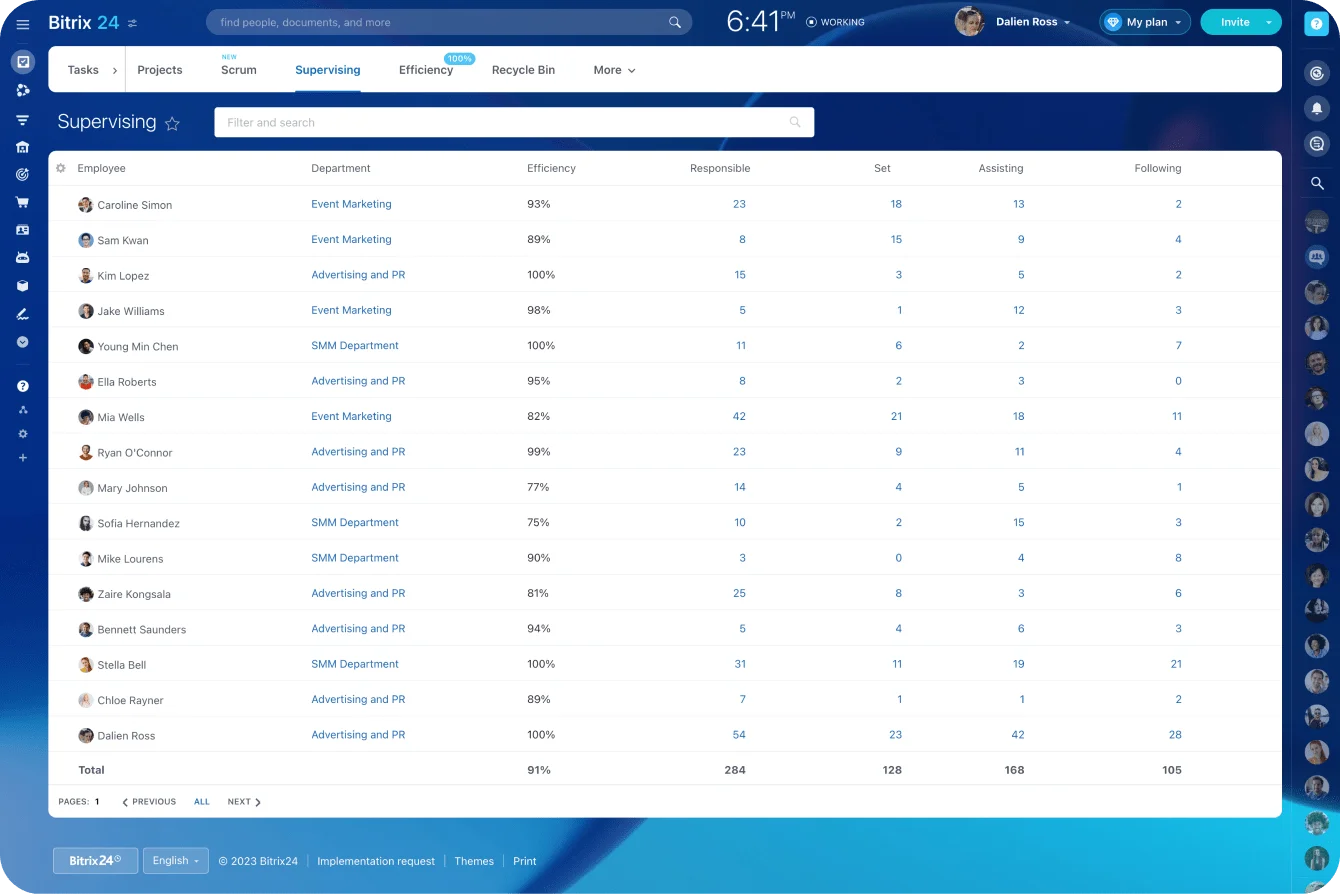
That's where Bitrix24 shifts the picture. By putting tasks, deadlines, workload, and reporting in one system, managers stop guessing who has room, what's blocked, and where effort is going. Decisions get made on current reality rather than yesterday's assumptions.
What resource allocation means in a small business context
Resource allocation is the process of assigning available time, people, budget, and attention to the work that creates the most business value. Keeping everyone busy is only part of it. The harder question is whether effort is going to the right outcomes at the right time.
It helps to separate it from related terms:
- Scheduling is about when work happens
- Project management is about coordinating tasks and delivery
- Resource allocation sits above both, asking whether the right people are doing the right work, whether they have realistic capacity, and what tradeoffs are being made elsewhere
A business can be good at scheduling and still poor at allocation. It may schedule every task neatly while assigning critical work to the wrong people, leaving hidden work untracked, or spending expensive staff time on low-impact activities. Allocation is the discipline that links effort to business value.
Bitrix24 supports that broader view because it combines task management, projects, calendars, communication, and reporting in one environment. Managers can view assignments, deadlines, activity, and status in a connected system rather than piecing it together across separate tools.
Why better resource allocation directly affects profitability and team performance
Poor allocation shows up in familiar ways: missed deadlines, burnout, idle capacity, duplicated effort, and high-priority work crowded out by whatever feels urgent in the moment.
These aren't isolated team issues. They're commercial ones.
The cost of fragmented tools is well documented. A Planview study of 650 knowledge workers found that teams lose more than 20 hours per month when their collaboration tools aren't integrated or centralized. At a five-person team, that's roughly the equivalent of losing one full-time employee's monthly output to coordination overhead alone!
Small teams feel allocation mistakes faster
There's also less margin for error when roles are concentrated. One person often carries specialized knowledge or approval authority, so a bad allocation decision doesn't just affect one task. It creates knock-on delays across multiple workflows. The same is true for budget: a poorly timed spend, or failure to redirect effort early enough, can leave the business short on both cash and delivery capacity.
Better allocation improves profitability by increasing useful output from existing resources. That doesn't mean squeezing more from the team. It means reducing waste:
- Less waiting on approvals or information
- Less rework from unclear handoffs
- Less context switching between tasks with no clear priority
- Better alignment between who does what and what actually matters
Bitrix24 supports those outcomes in practical ways. Clear ownership reduces drift. Workload visibility helps managers redistribute tasks before someone hits overload. Progress tracking makes stalled work easier to spot before it becomes a delivery problem.
How resource allocation works inside Bitrix24
Most allocation problems stem from three questions: what work exists, who owns it, and who still has capacity.
Bitrix24 helps answer those questions by connecting tasks, projects, calendars, workload tracking, and reporting in one system. Work is captured as tasks or projects, assigned to specific people, tied to deadlines, moved through statuses, and tracked over time. Managers can then review capacity and progress in one place rather than piecing together updates from separate spreadsheets, chat threads, and calendar entries.
What each layer adds
Tasks and projects give work a structure. A task linked to an owner, a deadline, a dependency, and tracked time starts to reveal whether the planned workload is realistic — which a standalone task list can't do on its own.
Calendars help teams see timing conflicts and shared deadlines before they collide. Task dependencies show which items can't move until earlier work is complete, making sequencing visible rather than implied. Workload views reveal where assignments are concentrated: if one person is carrying too many active tasks while another has room, the imbalance surfaces before it becomes a missed deadline.
Time tracking adds the layer most teams skip: how much effort tasks actually consume, not just how long managers assumed they would take. That gap between estimate and reality is where project budgets quietly disappear. And keeping communication centralized means task-related discussion stays close to the actual work item, lowering the chance that important changes live only in chat threads while the official plan stays outdated.
|
Area |
Manual resource allocation |
Resource allocation in Bitrix24 |
|---|---|---|
|
Visibility |
Split across spreadsheets, chats, and calendars |
Tasks, deadlines, workload, and status visible in one system |
|
Coordination |
Relies on memory and repeated check-ins |
Assignments, notifications, and dependencies keep work aligned |
|
Reporting |
Often manual and delayed |
Dashboards, completion reports, and time data available continuously |
|
Risk of overload |
Detected late, after deadlines slip |
Workload imbalance visible before it becomes a delivery problem |

Core Bitrix24 features that support smarter allocation
Time planning
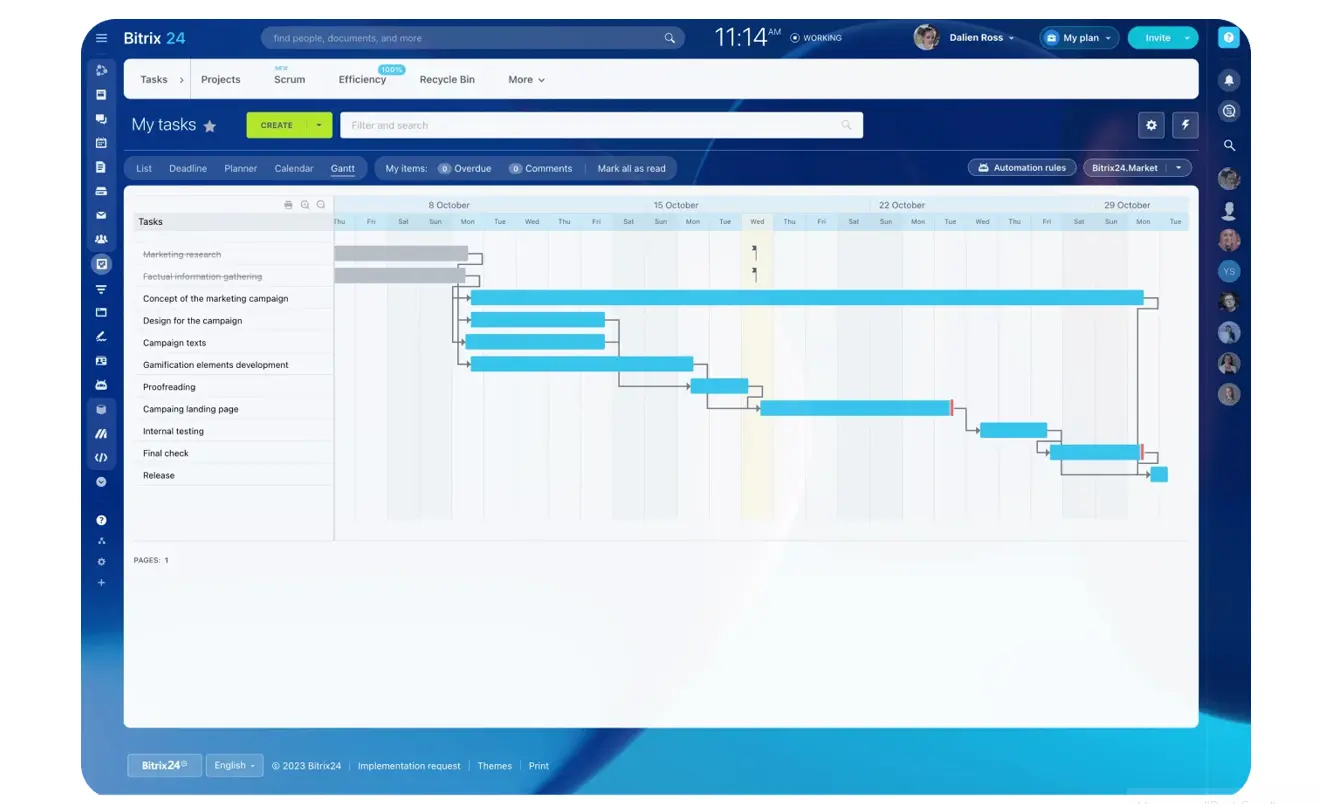
Teams can use task lists, Kanban boards, and Gantt-style timelines to see upcoming work, sequencing, and deadlines. A common pattern: a team looks calm on Monday, then three deliverables land on the same Thursday because nobody mapped the dependencies. Gantt views make that collision visible before it happens.
People and capacity
Tasks can be assigned clearly, ownership made explicit, and progress reviewed across individuals or teams. This makes it easier to balance work based on actual load rather than instinct.
Bitrix24's workload views show who has room and who's already at capacity, something a spreadsheet can approximate but not update in real time.
Budget-conscious decisions
Small businesses don't typically need complex financial planning tools for day-to-day allocation. They do need to know whether team effort is tracking against project expectations, whether scope is expanding, and where time is going relative to priorities. Reporting and project visibility give managers those answers on demand rather than at the end of a billing cycle.
Reducing coordination overhead
Recurring tasks, templates, automation rules, and notifications handle a less obvious cost: the time spent recreating and re-explaining routine work. Bitrix24's task automation standardizes repeatable processes so less management time goes to setup, follow-up, and reminder chasing.
|
Resource decision |
Planning tools |
Monitoring tools |
Reallocation tools |
|---|---|---|---|
|
Time |
Task lists, Kanban, Gantt, calendars |
Deadlines, statuses, tracked time |
Rescheduling, dependency changes, priority updates |
|
People |
Task assignment, templates, project structure |
Workload views, completion reports, activity tracking |
Reassignment, notifications, shared task visibility |
|
Budget-sensitive work |
Project grouping, scoped task planning |
Reports, time tracking, progress dashboards |
Priority shifts, pausing low-value work, redirecting effort |
Common resource allocation mistakes small businesses make
Assigning work based on availability rather than fit
Availability is only one factor. Capability, context, and the cost of switching matter too. Giving a task to the wrong person may fill an empty slot on paper while creating slower delivery and more revisions in practice. A senior developer pulled into routine QA work is misallocated, and a bottleneck for the next thing that actually needs their judgment.
Ignoring hidden work
Small businesses often track client-facing tasks but miss internal approvals, prep work, follow-ups, admin, and rework. Managers then wonder why the team feels overloaded despite a reasonable-looking project plan. The missing work was real all along; it just never entered the system.
Overcommitting top performers
Because reliable people deliver, they attract more work. Over time they become a bottleneck, not because they're weak, but because critical tasks keep routing through the same few people. Bitrix24's workload views make this pattern visible before it turns into a personnel problem or a missed deadline.
Confusing planned effort with actual effort
Without time tracking or solid task history, businesses assume a task takes two hours because that's what it should take. In reality, interruptions, review cycles, and dependencies push it much higher. That gap between estimate and reality is where project budgets quietly disappear.
Fragmented tools amplifying all of the above
Spreadsheets show lists but not live progress. Chat threads contain updates but not structured accountability. Memory-based planning works until complexity rises a little, then blind spots appear everywhere.
Bitrix24 helps by making ownership, status, and workload visible in the same place, removing many of the informational gaps that cause bad allocation decisions before they become bad outcomes.

Real-world small business use cases
Marketing agency
Designers, copywriters, and account managers are typically shared across several client campaigns. Without a centralized view, work gets assigned based on urgency and whoever answers first.
In Bitrix24, the agency can organize each campaign as a project, break deliverables into tasks, assign owners, set due dates, and monitor team workload across accounts. That makes it easier to avoid the situation agencies consistently over-report as their biggest capacity problem: three launch deadlines landing on the same designer in the same week.
Service business
Office staff handle scheduling and approvals while field staff deliver the work. Delays often happen at the handoff points.
With Bitrix24, tasks can be tied to deadlines, responsibilities, and dependencies so office and field teams work from the same timeline. If an approval is delayed, managers see the downstream impact rather than discovering it after a service window is missed.
Retail and seasonal campaigns
A seasonal promotion may involve merchandising, supplier coordination, marketing content, in-store execution, and reporting. By mapping these as connected tasks, the retailer can decide whether to delay a lower-value initiative instead of stretching the team across both. That's a tradeoff that often gets made too late, after launch prep has already consumed more capacity than expected.
A practical example: product promotion planning
Suppose a small business is running a product promotion. The work breaks into tasks: campaign brief, design assets, landing page update, email copy, approval review, launch setup, and post-launch analysis. Each task has an owner, deadline, and dependency:
- Design can't finish before the brief is approved
- Email can't go out until the landing page is ready
- Time tracking shows if creative review is taking far longer than planned
Instead of discovering overload the day before launch, the manager sees the buildup earlier and can shift review work or adjust timing.
Analytics and reporting tools close the loop, showing who's overloaded, which tasks repeatedly go overdue, and where underused capacity exists. If one coordinator is finishing tasks early while another is buried in admin-heavy work, assignments can be redistributed based on evidence rather than perception.
Operational impact, scaling, and honest limits
What improves first
When resource allocation improves, day-to-day operations usually feel calmer before they look dramatically different on paper. Teams spend less time firefighting. Planning becomes more predictable. Managers have fewer last-minute surprises because work is visible earlier and bottlenecks surface sooner.
This also changes workload sustainability. A business that always relies on heroic effort isn't well allocated, even if deadlines are technically met. More balanced assignments reduce burnout risk and make output less dependent on a few overextended employees.
What scales better
As the company adds clients, employees, or projects, standardized workflows grow in value. Shared task structures, recurring processes, common reporting, and visible ownership make it possible to increase activity without adding the same amount of managerial overhead. More work can move through the system without everything depending on constant manual coordination.
What Bitrix24 can't fix
Bitrix24 improves decision quality by making work easier to plan and monitor, but results depend on inputs. If priorities are unrealistic, tasks are poorly defined, or managers avoid making tradeoffs, the platform can't solve that.
Team adoption matters too. If people work outside the system, skip updates, or don't record time where needed, visibility degrades. And allocation is ultimately a business judgment problem: what matters most, what can wait, and who should carry which responsibilities at a given moment.
Bitrix24 gives managers better information to make that call. The call itself still belongs to them.
Improve resource allocation with Bitrix24
Small businesses need a clear view of what needs doing, who owns each task, and where capacity is already under pressure.
Bitrix24 gives managers that visibility by connecting tasks, projects, calendars, workload planning, time tracking, communication, and reporting in one workspace. That makes it easier to assign work realistically, spot bottlenecks earlier, and keep valuable time focused on the work that matters most.
If your team is busy but deadlines still slip, resource allocation is the place to start.
Explore Bitrix24 to see how your business can plan work, manage capacity, and make better use of the resources you already have.
Allocate work smarter with Bitrix24
Plan tasks, track workload, manage time, and spot bottlenecks in one workspace so your small team delivers without overload.
Get Started NowFAQ
Can Bitrix24 help if my team is very small and one person handles multiple roles?
Yes, and mixed-role teams often benefit quickly. Role overlap creates hidden workload. When one person is handling sales support, operations, and project follow-up, it's easy to underestimate their true capacity. Centralized task visibility and workload monitoring make that combined load easier to see and manage.
What if priorities change every week or urgent work constantly interrupts the plan?
That's common in small businesses. Bitrix24's dynamic task boards, reassignment, and reporting let managers shift work without losing accountability. Plans can change, but the business still needs a record of what moved, who owns it now, and what deadlines were affected.
How can I tell whether we have a resource shortage or just poor task planning?
Look at workload data, time tracking, overdue patterns, and completion reports together:
- If the same people are overloaded while others have room → likely an allocation issue
- If tasks consistently take much longer than assumed → planning may be weak
- If everyone is fully utilized and priority work still slips → that points toward a real capacity shortage
Bitrix24 helps distinguish between those situations because it shows both planned work and actual execution signals in one place.
How often should small businesses review resource allocation?
Most small businesses benefit from a weekly review. Daily reviews often create unnecessary churn, while monthly reviews are usually too slow to catch developing bottlenecks. A short weekly review of workload, overdue tasks, upcoming deadlines, and capacity is often enough to identify problems before they affect delivery.