SEO for Dummies

Do you run a website – or are you planning to launch one soon? Whether it's an online store, a service website, a blog, or a landing page, the goal hasn't changed much over the years: attract the right visitors and turn them into customers.
What has changed is how people find websites. In 2026, search engines don't just show lists of links. They summarize answers using AI Overviews, power conversational AI Mode search, and decide which sources are trustworthy enough to be cited.
Organic search traffic is still one of the most valuable (and cost‑effective) channels – but only if your content is built for both humans and machines.
This guide explains SEO in clear, practical terms, and shows how small businesses can stay visible in an AI‑first search landscape.
What Is SEO in Simple Terms?
SEO (Search Engine Optimization) is the practice of improving your website so search engines – and AI systems trained on their data – can:
- Understand what your content is about
- Trust its accuracy and relevance
- Decide when to surface it in search results, AI summaries, and voice answers
To put it simply: SEO helps the right people find you when they search.
While paid ads still occupy the top spots, organic results (and AI‑generated answers) drive the majority of high‑intent clicks. Studies consistently show that the first organic results – or AI citations – capture most user attention.
Imagine running a pizza delivery business in Brooklyn. If your site doesn't appear on the first page or inside AI Overviews for “best pizza delivery in Brooklyn,” your amazing pizza stays invisible. SEO is how you compete for your slice of that pie.
SEO made simple — even in the AI era
Build search-ready websites, publish structured content, and manage everything in one place with Bitrix24
GET STARTED FOR FREEHow Search Engines Work in 2026
Search engines have evolved far beyond simple keyword matching. Today, they combine:
- Crawlers that scan and index pages
- Large Language Models (LLMs) that interpret meaning
- Entity graphs that connect brands, topics, people, and places
- Real‑world signals like brand mentions, reviews, and user engagement
Instead of asking “Does this page contain the keyword?”, modern systems ask: “Does this content fully answer the user's question, and can we trust it?”
That's why SEO today focuses on clarity, usefulness, and authority, not shortcuts.
Core SEO Concepts You Still Need to Know
1. Keywords & Search Intent
A keyword is what a user types (or says) when searching – for example, “pizza delivery Brooklyn.”
In 2026, keywords matter less as isolated phrases and more as signals of intent. Search engines group related queries into topics and entities.
2. Long‑Tail Keywords
Long‑tail queries are longer, more specific searches like: “best late‑night gluten‑free pizza delivery in Brooklyn.” They're less competitive and often convert better – especially for small businesses.
3. Meta Titles & Descriptions
These short snippets help both users and AI understand your page before clicking. Clear, descriptive metadata improves click‑through rates and AI citation likelihood.
4. On‑Page vs. Off‑Page SEO
On‑page SEO: content quality, structure, headings, internal links, page speed, mobile usability, etc.
Off‑page SEO: backlinks, brand mentions, reviews, citations, and overall authority
Both still matter – but quality beats quantity every time.
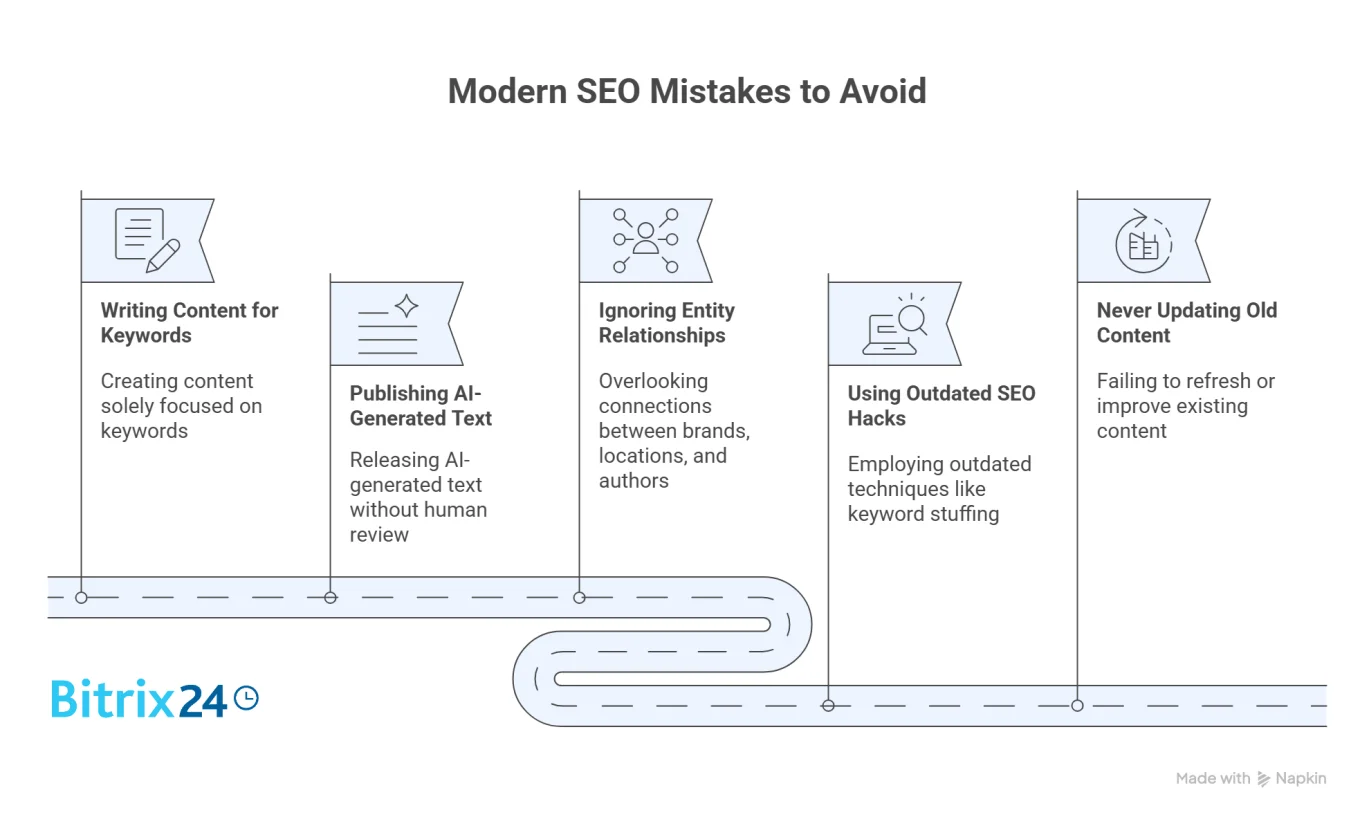
Modern SEO Mistakes to Avoid in 2026
- Writing content only for keywords, not answers
- Publishing AI‑generated text without human editing
- Ignoring entity relationships (brands, locations, authors)
- Outdated “SEO hacks” like keyword stuffing
- Never updating old content
If your content wouldn't help a real person, AI won't recommend it either.
AI‑Driven SEO Optimization in 2026
How AI Overviews & AI Mode Change Discoverability
AI Overviews summarize answers directly on the results page. AI Mode allows conversational follow‑ups. In both cases, only a few sources are selected – and visibility often means being cited, not just ranked.
How AI Evaluates Content
Search systems use LLMs to assess:
- Semantic proximity: how closely your content matches the question
- Entity relationships: brands, products, locations, authors
- E‑E‑A‑T signals: experience, expertise, authority, trust
- Content structure: clarity, scannability, definitions
Best Practices for AI‑Optimized Content
Make content citation‑friendly:
- Use clear definitions (e.g., “SEO in 2026 means…”)
- Add step‑by‑step how‑to blocks
- Include fact‑style statements and summaries
Improve AI readability:
- Descriptive headings
- Short paragraphs
- Bullet points and tables
- Logical content flow
Strengthen trust signals:
- Clear author info
- Updated data and examples
- Transparent claims
AI Summary‑Ready tip example: SEO in 2026 focuses on helpful content, entity relevance, and trust signals rather than keyword density.
Where Bitrix24 Fits In
Businesses using Bitrix24 can create fast, SEO‑ready websites with structured pages, clean code, and built‑in tools. The platform's no‑code website builder integrates content, CRM, product catalogs, invoices, and payments – making it easier to maintain consistent, AI‑friendly web experiences across your entire business.
SEO Tools That Still Matter
- Google Analytics & Search Console
- Keyword research platforms (Keyword Planner)
- AI content optimization tools (used responsibly)
- All‑in‑one tools like the Bitrix24 website platform that combine site building, content management, and analytics
The best tools save time – but strategy still comes first.
SEO Checklist for 2026 (Beginner‑Friendly)
Content & Keywords
- Research topics, not just keywords
- Match content to search intent
- Update existing pages regularly
Structure & UX
- Clear headings (H1-H3)
- Mobile‑first design
- Fast-loading pages
Trust & Authority
- Real authors and bios
- Internal links between related content
- External references where relevant
AI Readiness
- Answer questions directly
- Use concise summaries
- Avoid fluff
SEO that still works in 2026
Create clear, structured content and manage your website with built-in tools in Bitrix24.
START FOR FREEFAQ
What is SEO in 2026?
SEO in 2026 focuses on creating helpful, trustworthy content that search engines and AI systems can easily understand, summarize, and recommend.
Does AI replace traditional SEO?
No. AI changes how SEO works, but fundamentals like content quality, structure, and authority remain essential.
How do AI Overviews choose which pages to cite?
They prioritize clear answers, strong entity relevance, and trusted sources with consistent signals across the web.
Can small businesses compete with big brands?
Yes. Niche expertise, local relevance, and well‑structured content often outperform generic big‑brand pages.
What is entity‑based SEO?
It focuses on optimizing around people, brands, products, and topics – not just keywords.
Do backlinks still matter in 2026?
Yes, but quality and relevance matter far more than volume.
How often should SEO content be updated?
Review important pages every 6–12 months, or sooner if information changes.
What tools help automate SEO tasks?
Analytics tools, AI content assistants, and all‑in‑one business website solutions streamline research, publishing, and optimization.
How can I build an SEO‑friendly website easily?
Using website builder tools like Bitrix24 helps ensure clean structure, fast performance, and integrated marketing features from day one.
Final Thoughts
SEO isn't about tricking search engines – and it never really was. In 2026, the winners are businesses that:
- Publish genuinely helpful content
- Structure it clearly
- Build trust over time
- Use modern platforms like Bitrix24 to execute faster
Do that, and both humans and AI will find you.