Navigating Business Growth Challenges Using Bitrix24

Growth usually breaks coordination before it clearly boosts performance. More customers and more staff can look like progress from the outside, but internally they tend to produce handoff failures, slower decisions, and uneven execution long before revenue gains feel stable.
Teams no longer know who owns what. Customer context gets lost between departments. Managers spend more time chasing updates than making decisions.
Most fixes target the wrong layer. Hiring a sales lead or buying another point tool adds capacity without addressing why coordination is failing, which is that information, ownership, and follow-through are scattered across systems that don't talk to each other.
Bitrix24 keeps those connected — communication, customer records, tasks, workflow rules, and reporting in one place — so adding volume doesn't mean losing control.
The rest of this piece looks at where that actually helps, where teams get it wrong, and what it takes to roll out during active growth.

What business growth challenges actually look like in practice
Growth increases complexity across five areas simultaneously: sales, project delivery, internal communication, customer support, and reporting. Each one can still function in isolation for a while. The trouble starts when they need to function together.
McKinsey research found that the average knowledge worker spends nearly 20% of their working week just searching for internal information or tracking down colleagues. That’s one full day per week, per person, not spent doing the work but locating what's needed to start it.
The costs show up in predictable ways:
- Delayed decisions: When information lives in separate inboxes, spreadsheets, and department-specific apps, managers can't see the full picture fast enough. Teams compensate by scheduling more meetings and escalating more often (which feels like activity but is really coordination overhead).
- Duplicated work: Sales updates one system, operations recreates the same details elsewhere, and finance asks for clarification because no one trusts the original record. The same information gets entered three times and still isn't reliable, because there's no single version everyone works from.
- Declining customer experience: Follow-ups become inconsistent. Handoffs between sales and delivery lose context. Support teams respond without full account history (which hurts revenue retention just as much as it hurts satisfaction).
|
Operating model |
Typical outcome during growth |
|---|---|
|
Disconnected tools |
Fragmented data, slower handoffs, duplicate work, inconsistent customer experience |
|
Unified business platform |
Shared visibility, clearer ownership, faster coordination, more consistent execution |
System design matters here because growth pressure amplifies weak links. What works for 10 people with high trust and informal communication often fails at 50, and struggles badly at 150.
How Bitrix24 supports growth across day-to-day operations
The core logic of Bitrix24 is straightforward: it centralizes the information and actions that growing teams need to coordinate. Communication, customer data, work tracking, approvals, and recurring workflows live in one environment rather than spread across separate systems.
That creates a shared source of truth in a practical sense. Teams can see the same customer record, the same task owner, the same deadline, and the same status without asking around. When growth increases volume, that shared visibility becomes a control mechanism.
Here's what that looks like in motion:
- A lead enters the CRM through a form, email, call, or message channel.
- It gets assigned based on rules or ownership logic — no manual routing required.
- Related tasks are created for follow-up, with deadlines and owners attached.
- Internal comments stay tied to the task or record, not buried in a side conversation.
- Automations trigger reminders, status changes, or approval requests at the right moment.
- Managers see performance and pipeline data through dashboards and reports — without chasing updates.
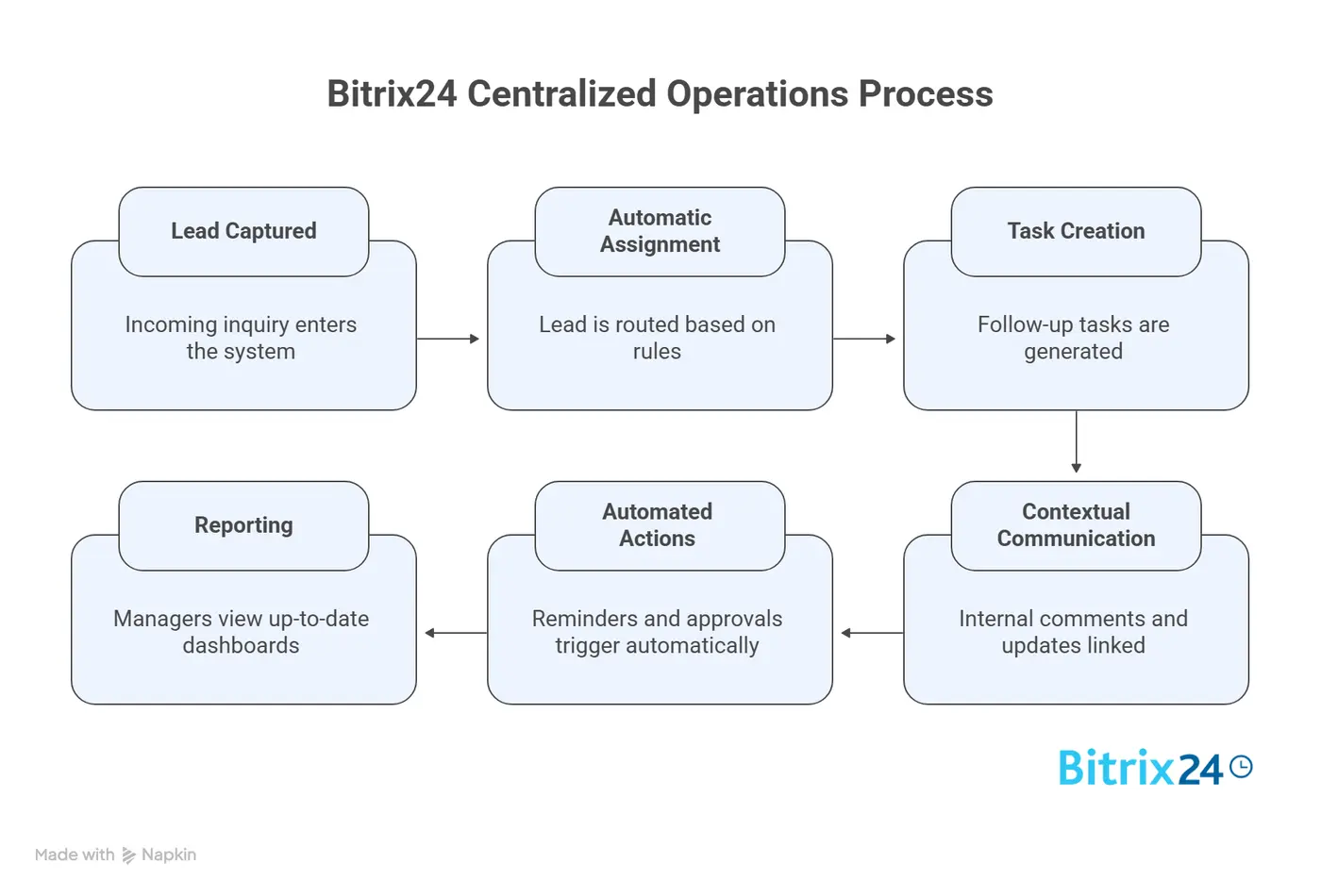
The value comes less from any single feature than from the combined coordination model.
CRM without task discipline leaves execution gaps. Chat without workflows creates noise. Reporting without shared data produces weak analysis.
Bitrix24 is most useful when sales, operations, and collaboration are linked, so the business can absorb more activity without losing control.
Core Bitrix24 capabilities that address common scaling bottlenecks
Growing companies usually hit the same bottlenecks in different forms. Customer history becomes scattered. Work gets assigned informally. Internal alignment weakens. Approvals slow down. Reporting turns reactive. Sound familiar? Here’s how Bitrix can fix them.
CRM and customer continuity
As lead volume and account complexity grow, centralized customer records become essential. Bitrix24 CRM keeps contact history, deal stages, activities, notes, and communication records tied to the customer.
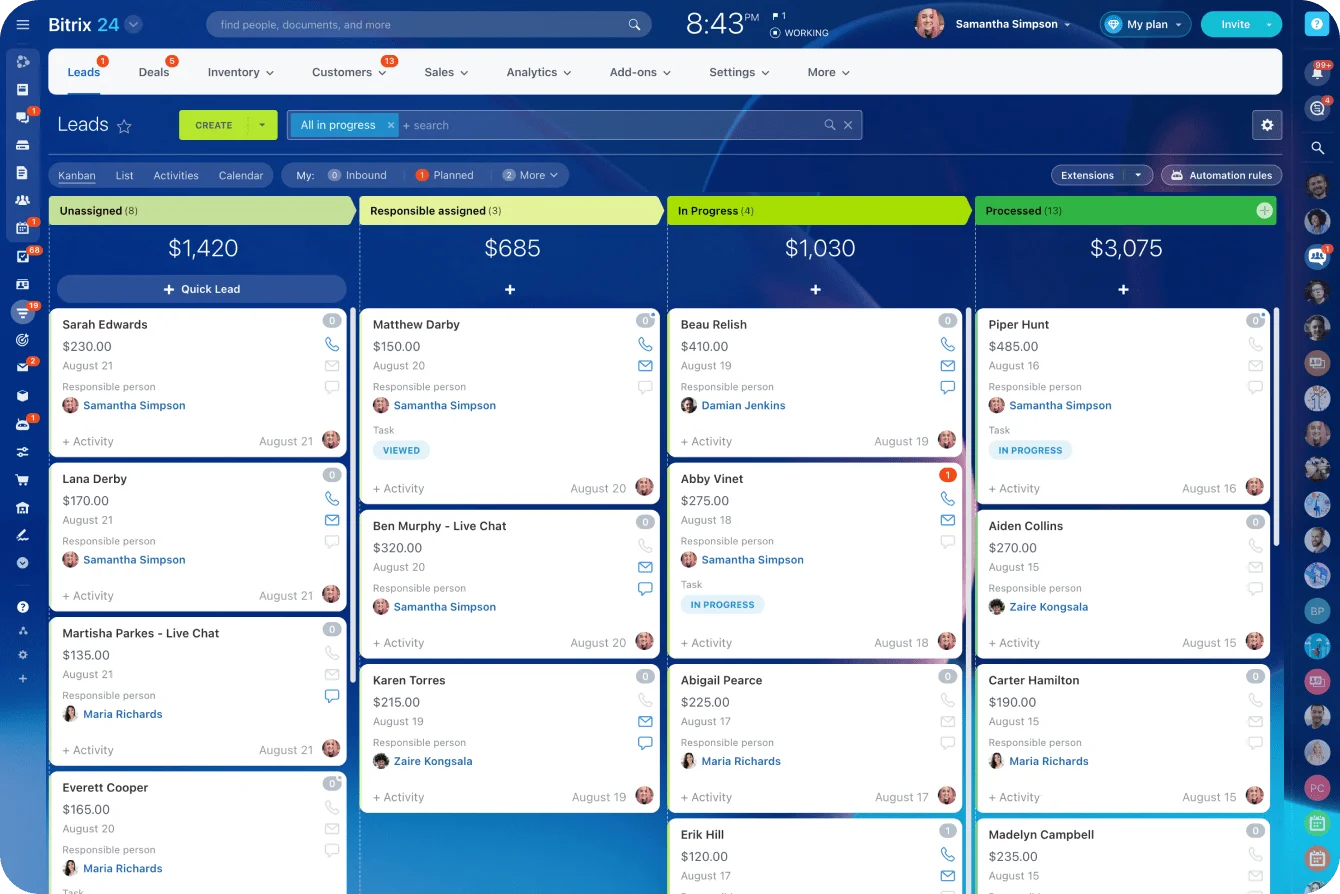
A sales team managing 200 active opportunities across three reps — all using different follow-up habits — will quickly lose track of who said what and when. Centralized records fix that. They also reduce the "who spoke to this client last?" problem when accounts change hands or team members leave.
Tasks and projects for execution discipline
Fast-growing companies often rely on verbal commitments or ad hoc message threads to move work. That falls apart quickly. When a sales rep promises a proposal by Thursday, the project team needs to know that — and know who's responsible for it.
Bitrix24 tasks and project tools make ownership, deadlines, dependencies, and status visible. This is especially useful when sales promises have to become delivery actions across departments.
Chat and intranet tools for internal alignment
Growth adds communication volume, but more messages don't automatically create better coordination. Bitrix24's collaboration layer gives teams channels for discussion while keeping work-related communication closer to the actual tasks, records, and teams involved (rather than buried in a general chat that nobody scrolls back through).

Workflow automation for repeatable processes
Repetitive approvals, notifications, follow-ups, and status transitions are easy places for scaling friction to appear. A five-step onboarding checklist that worked when HR handled three new hires a month stops working when that number becomes 15.
Automation reduces delay and inconsistency when applied to stable, high-frequency processes.
Supporting controls that matter at scale
- Dashboards help managers spot bottlenecks before they become crises, rather than discovering a pipeline stall in the weekly review.
- Permissions allow visibility without chaos — critical as more roles and departments enter the system.
- Document management keeps shared files tied to the work they support, rather than floating in a shared drive with no context.
- Multi-channel communication brings calls, email, social messages, and chat inquiries into the same operational flow.
|
Growth challenge |
Bitrix24 capability |
Business effect |
|---|---|---|
|
Missed handoffs between teams |
Shared task ownership and project tracking |
Clear accountability and fewer dropped actions |
|
Scattered customer history |
Centralized CRM |
Better continuity across sales, service, and delivery |
|
Slow approvals |
Automated workflows |
Faster internal decisions and less manual chasing |
|
Fragmented internal communication |
Chat, workgroups, intranet tools |
Stronger team alignment around active work |
|
Weak management visibility |
Dashboards and analytics |
Quicker intervention and more predictable execution |
|
Growing communication channels |
Multi-channel contact center |
More consistent customer response handling |
Common mistakes and misconceptions when using platforms to scale
A platform doesn't fix a scaling problem by itself; it gives the business a structure for coordination. But if core processes are unclear or ownership rules are weak, the system will reflect that confusion at a greater scale.
Over-customizing too early
Companies often try to tailor every field, workflow, and dashboard before anyone has fully adopted the tool. That creates clutter fast, makes the system harder to govern, and means significant rework when the business evolves. Which it will.
Running parallel systems
If sales uses the CRM but delivery still runs from spreadsheets and support stays in separate inboxes, the company keeps the same coordination problem with added software overhead. The platform can only provide visibility into what's actually inside it.
Automating broken processes
Automating a broken process doesn't make it scalable; it just makes the broken process happen faster and more consistently. Before setting automation rules, teams need basic process clarity: who owns the action, what triggers it, and what a successful outcome looks like.
Treating CRM as a sales-only database
In growing businesses, customer records matter far beyond the sales team. Service teams, account managers, project staff, and leadership all benefit when customer context is shared and current. Keeping the CRM siloed in one department defeats the point.
The strongest use of Bitrix24 tends to follow a simple principle: standardize where consistency matters, allow flexibility where teams genuinely differ, and apply enough governance to stop the system from turning into operational sprawl.

Real-world business use cases for growing teams using Bitrix24
Fast-growing sales teams
A sales team that routes leads manually and tracks activity in spreadsheets will start dropping follow-ups once it handles more than 50 to 100 active opportunities simultaneously. Bitrix24 CRM can route incoming leads, track activity against opportunities, and give leadership a clearer view of stage progression, response timing, and follow-up consistency (without a weekly round of status calls).
Service and project-based businesses
The gap between "closed won" and "project kicked off" is where service businesses most often lose context and customer trust. Bitrix24 connects customer records, task workflows, internal discussions, and approvals so that execution doesn't depend on memory or side messages — and the delivery team knows what was promised before they start.
Distributed and remote teams
Teams that rely on email chains for approvals will typically see those chains stall or fork, meaning decisions get made on outdated information. Centralizing communication and routine approvals in one workspace reduces that delay and keeps visibility consistent across locations.

Onboarding at scale
As hiring accelerates, informal checklists stop working. A shared platform can track onboarding tasks, documents, responsibilities, and internal communication across HR, IT, and department managers — reducing the risk of a new hire's first week becoming a scramble for basic access and information.
High-volume customer support
When more customers contact the company across email, chat, social channels, or phone, response quality often becomes inconsistent. A unified contact center helps teams manage requests with more context and less channel fragmentation — so a customer who emailed yesterday and called today isn't treated as two separate cases.
|
Business context |
Typical growth challenge |
How Bitrix24 helps |
|---|---|---|
|
SMB moving beyond informal processes |
Work depends on memory and direct supervision |
Introduces shared records, tasks, and basic workflows |
|
Fast-growing sales organization |
Lead routing and pipeline control become inconsistent |
Centralizes CRM activity and improves visibility |
|
Service or project-based company |
Sales-to-delivery handoffs lose detail |
Connects customer context to execution tracking |
|
Multi-location or distributed team |
Approvals and communication become fragmented |
Provides a common workspace across locations |
Scaling impact, trade-offs, and where Bitrix24 fits best
Growth rarely breaks because a company lacks the right software. It breaks because work, customer context, and communication end up scattered across tools that don't talk to each other, and coordination gets quietly more expensive every month.
Bitrix24's value is putting those back in one place, so the business can take on more volume without losing track of who owns what. Used well, that's the difference between growth you can manage and growth that manages you.
Start for free, or compare the pricing plans to see what each tier includes.
Scale growth without losing coordination
Bitrix24 brings CRM, tasks, chat, automation, and reports together so growing teams keep ownership clear and execution on track.
Try Bitrix24 NowFAQ: Practical questions growing companies ask before adopting Bitrix24
Can Bitrix24 support growth if our processes are still evolving?
Yes, as long as the company has enough clarity to define basic ownership, stages, and recurring actions. Processes don't need to be perfect — they need to be coherent enough to structure inside a shared system. Trying to implement a platform before any process clarity exists will produce a system nobody trusts.
What happens if different teams need different workflows?
That's normal. Different functions often need different workflow logic. The key is to allow variation where work genuinely differs while keeping shared data, visibility, and handoff rules consistent across the business.
How does it help when remote and in-office teams scale at the same time?
It provides a common workspace for communication, tasks, approvals, and customer context. That reduces the risk of location-based silos and helps teams work from the same operational picture, regardless of where they're based.
Is Bitrix24 better for sales-heavy companies only, or can operations, HR, and service teams benefit too?
It's broader than a sales platform. Sales teams may be the first users, but operations, HR, service, and management teams benefit when work, communication, and reporting are connected instead of split by department.
When does an all-in-one platform become more useful than separate specialized tools?
Usually when coordination costs become more damaging than feature gaps. If the company is losing time and quality because information is scattered, a unified platform often creates more value than another standalone tool.
Sustainable growth depends less on raw volume than on coordination quality. Bitrix24 helps growing companies scale structure, communication, and execution together — which is often what separates manageable growth from operational drift.