Marketing automation in CRM: turning data into growth
Customer engagement has never been harder than now. People expect fast, personalized replies no matter if they contact you via email, WhatsApp, or social media. At the same time, marketing teams are drowning in tools that don't talk to each other.
One app for email campaigns, another for SMS, a different CRM for storing customer data – and still no clear view of who your customer is or how to engage them at the right time.
That's why marketing automation inside CRM systems is such a game-changer. When your CRM becomes more than a database and transforms into a living, breathing engagement hub, you unlock growth that scales.
In this article, we'll explore why traditional approaches fall short, how integrated automation solves those issues, and why CRM Marketing inside Bitrix24 stands out as a solution designed for today's fast-moving businesses.
Why do traditional CRM and marketing tools fail to deliver?
Most businesses already use a CRM or a marketing platform. But when they're separate, they often create friction, blind spots, and missed opportunities.
Data silos and lost opportunities
A traditional CRM might store contacts, leads, and deals. Meanwhile, your marketing platform manages email newsletters, SMS blasts, or Facebook ads. The problem? The two rarely talk to each other properly.
- A new lead comes in via social media, but your marketing platform doesn't know it exists
- Your sales team follows up on a deal, but marketing keeps sending generic promo emails
- Customer activity history is split across multiple apps
This siloed approach means nobody has the full picture. The customer feels misunderstood, and your team wastes time trying to connect dots that software should handle automatically.
Delayed responses and poor engagement
Another common pain point is speed. Modern customers expect instant acknowledgment when they reach out. A delay of even a few hours can feel like a snub.
Without built-in automation, your CRM leaves people waiting:
- A prospect submits a form and hears nothing until someone manually checks
- A client emails support but doesn't even get a confirmation message
- Someone comments on your Facebook page, but it never turns into a lead
Slow or missed responses don't just frustrate customers – they send them straight to competitors.
Take Your Business to The Next Level With Bitrix24
UNLIMITED USERS FREE
How does integrating automation fix CRM gaps?
When marketing and CRM work hand-in-hand, the game changes. Instead of fragmented tools, you get a single source of truth and workflows that run themselves.
Unified customer profiles
An integrated system creates a 360-degree view of each contact. That means every email, call, WhatsApp message, or social media interaction gets logged in one place. Sales, marketing, and support teams finally see the same story.
For example, if a lead came from Instagram, opened your last three newsletters, and called last week about pricing, your CRM shows all of that in one record. That's powerful context when deciding the next move.
Instant autoresponders
Automation allows for real-time engagement. When someone fills out a form, sends a message, or calls, an autoresponder in CRM can instantly acknowledge them. That could mean:
- A “thanks for reaching out” email
- An SMS with a link to book a meeting
- A WhatsApp message confirming their request
These automated responses bridge the gap until a human follows up, making customers feel heard and valued.
Multichannel automation
Modern engagement doesn't live in one channel. A truly integrated CRM with automation covers them all:
- Email campaigns for nurturing leads
- SMS reminders for appointments
- Messenger follow-ups after purchases
- Social media replies turned into CRM records
Instead of chasing customers across platforms, you manage everything from one dashboard.

What features make CRM with automation essential?
Not all marketing CRM solutions are equal. Here are the must-have features that separate modern platforms from outdated ones.
Email marketing automation tools
Email remains the backbone of digital communication. A CRM with email marketing lets you:
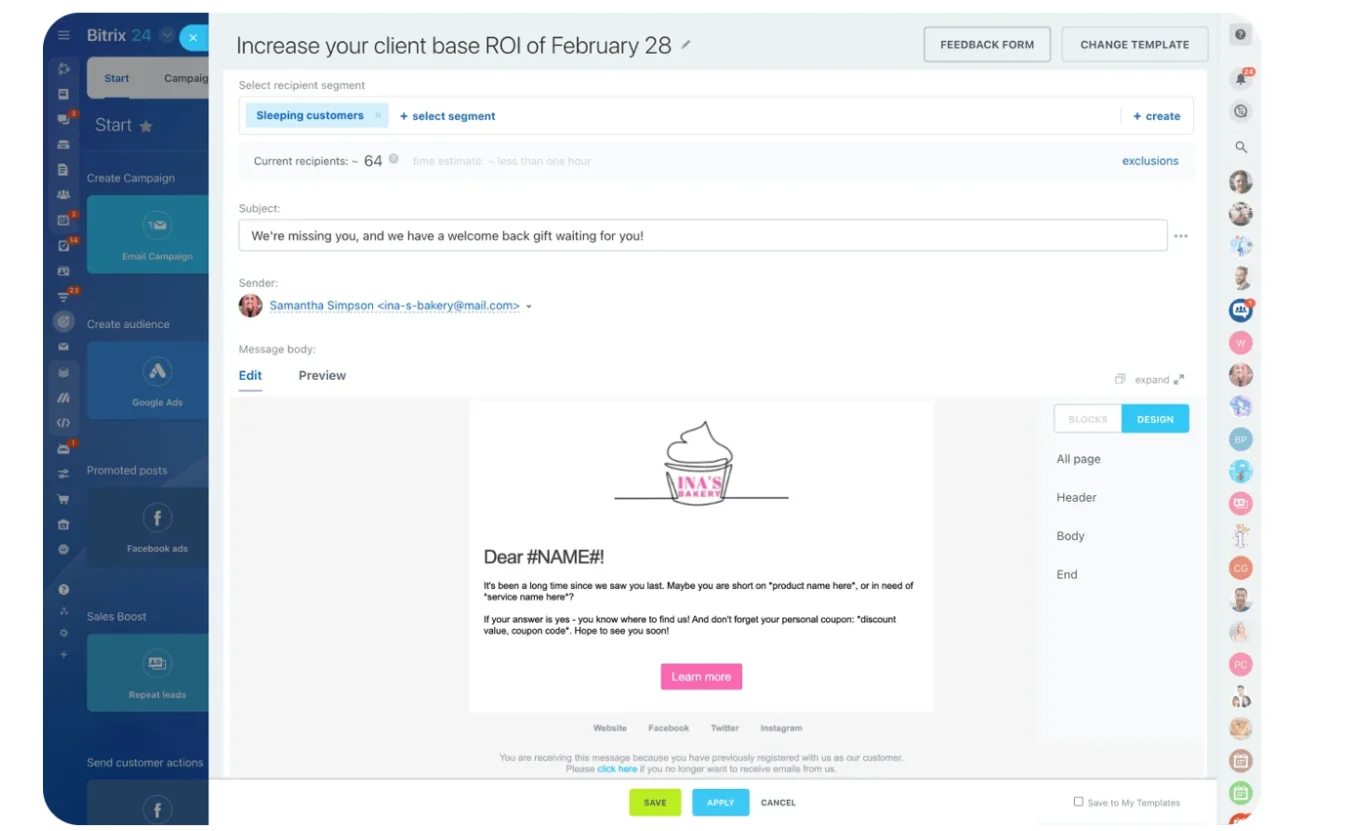
- Build and send professional campaigns without leaving your CRM
- Segment contacts by behavior, location, or deal stage
- Trigger automated sequences (welcome emails, abandoned cart reminders, follow-ups after purchase)
This turns one-off campaigns into ongoing conversations.
SMS and messenger workflows
Emails can get lost in crowded inboxes. SMS and messengers like WhatsApp and Telegram cut through the noise.
With automation, you can:
- Send appointment reminders by SMS
- Deliver personalized WhatsApp promos to loyal customers
- Automate Telegram messages for order confirmations
These quick, direct channels boost engagement rates significantly.
Lead nurturing and scoring
Automation shines when nurturing leads. Instead of generic blasts, you can design personalized journeys:
- Lead downloads an ebook → system sends a thank-you email
- After three days → follow-up SMS with an invitation to a webinar
- Lead attends webinar → sales rep notified automatically
Scoring adds another layer. Leads are automatically prioritized based on activity (opening emails, clicking links, visiting your site), so your team focuses on the hottest opportunities.
Analytics and campaign insights
Without data, marketing is guesswork. CRM marketing tools should provide clear analytics:
- Open and click rates for emails
- Conversion stats from SMS campaigns
- ROI per channel
When everything happens in the same system, insights are more accurate – and easier to act on.
How to choose the right CRM marketing automation software
If you're comparing solutions, it's easy to get lost in features. Here's how to evaluate effectively.
Comparison criteria
- Ease of use. Can your team actually use it day-to-day?
- Integration. Does it connect to your existing channels (email, phone, social, messengers)?
- Scalability. Will it grow with your business?
- Pricing. Transparent, flexible, and aligned with your needs
- Support. Is help available when you need it?
Mistakes to avoid
- Chasing “shiny” features without thinking about workflows
- Ignoring onboarding and training requirements
- Overlooking mobile usability (critical for sales teams on the go)
- Forgetting about compliance (GDPR, data security)
Why Bitrix24 CRM Marketing stands out
Here's where Bitrix24 (specifically, its CRM) shines:
- All-in-one Contact Center
Connect your email, phone, social media, and messengers in one place.
- Automatic lead capture
Every incoming email, call, or message can instantly become a lead, contact, or deal.
- Targeted campaigns
Build segments and reach clients via email, SMS, WhatsApp, or even robocalling.
- Flexible triggers
Automate messages based on birthdays, purchase history, or custom rules.
- Unified workspace
Sales, marketing, and support collaborate in one platform – no switching between tools.
For businesses frustrated by juggling multiple apps, this approach removes friction and delivers measurable results.
Measuring ROI and campaign success
Marketing automation isn't just about saving time – it's about proving impact.
Key metrics to track
- Response time. How fast do customers hear back?
- Engagement rates. Opens, clicks, and replies across channels.
- Lead conversion rate. How many leads become paying customers.
- Customer lifetime value (CLV). The long-term payoff of nurturing relationships.
- Campaign ROI. Revenue generated versus campaign cost.
Improving performance with automation
By constantly measuring and optimizing, you can:
- Identify the highest-performing channels
- Refine your lead nurturing journeys
- Double down on what works – and cut what doesn't
Future trends and innovations in CRM automation
The landscape is evolving quickly. Forward-looking businesses should follow these trends closely to see if they can capitalize on them.
Predictive AI and hyper-personalization
Artificial intelligence is moving CRM automation beyond rules and triggers. Future tools will:
- Predict customer needs before they act.
- Recommend next-best offers based on past behavior.
- Personalize every interaction to the individual, not just the segment.
Imagine your CRM suggesting the exact moment to send an SMS because it knows your customer is most likely to respond. That's where we're headed.
Final thoughts
When CRM and marketing automation tools finally work together, businesses stop wasting time and start building meaningful, scalable relationships with customers.
Instead of juggling multiple disconnected apps, you get one hub where data, communication, and campaigns flow seamlessly. For users of Bitrix24, CRM Marketing is more than just another feature – it's the missing link that transforms engagement into growth.
If you're frustrated with delays, data silos, or clunky tools, it's time to consider a solution designed to unify and automate. With the right approach, automation doesn't just save time – it delivers the growth your business has been waiting for.
Marketing made easy with Bitrix24!
Automate campaigns, track performance, and engage customers effortlessly with Bitrix24 CRM for marketing.
START NOW FREEFAQ
What is the main difference between CRM and marketing automation?
CRM focuses on managing customer relationships – storing contacts, tracking interactions, and supporting sales. Marketing automation adds the ability to send timely, personalized messages at scale through email, SMS, and messengers, helping you engage prospects and customers automatically. Together, they create a complete system for building and nurturing relationships.
How do I know if my company is ready for CRM with automation?
If you struggle with data silos, missed follow-ups, or inconsistent customer communication, it’s time to upgrade. CRM with automation ensures every interaction is captured and acted on, giving you faster response times and better customer experiences.
Can marketing automation improve customer loyalty?
Yes. Automated yet personalized touchpoints – such as welcome sequences, birthday messages, or post-purchase follow-ups – make customers feel valued and remembered, which boosts retention. Loyal customers are more likely to buy again and recommend your business.
How do I measure ROI from CRM marketing automation?
Track metrics like conversion rate, cost per lead, customer lifetime value, and engagement levels across channels. When you see faster response times and higher campaign conversions, you’ll know automation is paying off.
Why choose Bitrix24 for CRM and marketing automation?
Bitrix24 combines CRM, marketing automation, collaboration, and communication in one platform. That means no more juggling multiple apps – your team gets a unified workspace where leads, campaigns, and customer data flow seamlessly.